
Most SaaS companies struggle to explain their product clearly. You may have a powerful tool—but if your content is confusing, users leave. Your signup rates stagnate. Your organic traffic barely moves. And your competitors with simpler messaging are winning customers who should be yours.
That’s where technical blog writing makes the difference.
At its core, technical blog writing for SaaS isn’t about dumbing down your product. It’s about translating complexity into clarity—making your solution understandable, discoverable, and compelling enough to turn readers into paying customers.
If you’re a SaaS founder, marketing leader, or product manager tired of content that doesn’t move the needle, this guide will show you exactly how strategic technical blog writing services can transform your growth trajectory.
Why Generic Content Fails in SaaS (And What to Do Instead)
The biggest mistake SaaS founders make is treating their blog like a generic news outlet. Publishing posts like “5 Ways to Improve Productivity” might get clicks, but it won’t get sign-ups.
SaaS buyers are risk-averse. They need to understand how your software works before they trust it.
The Problem with “Surface-Level” Content
- It lacks EEAT: Google’s Helpful Content Update prioritizes experience. Generic AI-written content lacks the “First-Hand Experience” signal.
- It attracts the wrong traffic: Broad keywords bring in students and competitors, not decision-makers with budgets.
- It ignores the developer persona: If your API documentation is buried under sales pitch blog posts, developers will churn.
The Solution: Product-Led Technical Content
Instead of writing about why they should buy, write about how to solve the technical problem your product fixes.
- Bad: “Why Our Database is Fast”
- Good: “How to Reduce Query Latency by 40% Using Index Optimization (A Case Study)”
The Core Components of High-Impact SaaS Blogging
To drive real growth, your technical blog writing service must execute on three pillars: Depth, Architecture, and Conversion.
1. Deep Technical Depth (The “Expertise” Signal)
We don’t just research; we understand. Whether it’s a post about Kubernetes orchestration, Python libraries for data science, or headless commerce architecture, the content must be technically accurate.
- Code snippets and examples: Don’t just describe the feature; show the code.
- Architecture diagrams: Visualize the workflow.
- Real-world constraints: Discuss edge cases, security concerns, and scalability limits. This builds massive trust with technical buyers.
2. Topical Authority & Cluster Strategy
Google rewards sites that cover a topic exhaustively. We use the Hub-and-Spoke model:
- The Pillar (Hub): A 3,000+ word ultimate guide (e.g., “The Complete Guide to Serverless Architecture”).
- The Spokes: 10–15 supporting articles targeting specific long-tail keywords (e.g., “AWS Lambda vs. Azure Functions,” “Debugging Serverless APIs”).
- Internal Linking: We strategically link these articles to pass link equity and keep users in your ecosystem.
3. Search Intent Optimization
We analyze the SERP (Search Engine Results Page) for every keyword.
- Informational Intent: “What is GraphQL?” → We write a definitive guide.
- Commercial Intent: “Best API management tools 2024” → We write a comparison guide featuring your product (honestly).
- Transactional Intent: “How to integrate Stripe API” → We write a step-by-step tutorial that naturally leads to your documentation.
How Technical SEO Drives Revenue (Not Just Traffic)
Traffic is vanity; revenue is sanity. Our technical blog writing services integrate SEO from Day 1.
Winning SERP Features
We optimize content to win Featured Snippets and People Also Ask (PAA) boxes.
- Tactic: We structure H2/H3 headers as direct questions (e.g., “How does [Tool] handle API rate limiting?”) and provide concise 40–60 word answers immediately below.
- Result: You rank #0, above the first organic result, capturing high-intent clicks.
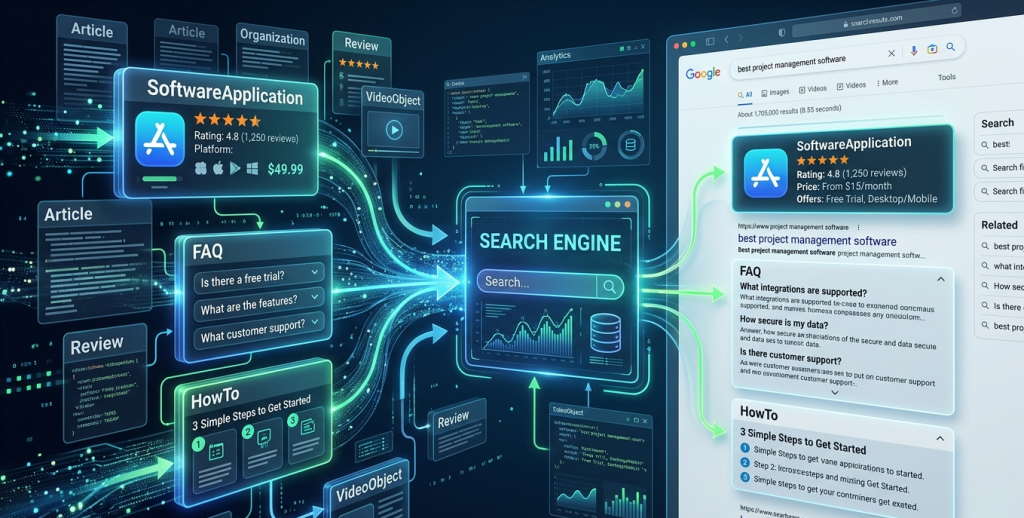
Schema Markup for Tech Brands
We implement structured data (Schema.org) to help Google understand your content type:
- SoftwareApplication Schema: To display pricing and ratings directly in search results.
- FAQ Schema: To expand your listing in the SERPs.
- HowTo Schema: To get your tutorials into Google’s “How-to” carousel.
Reducing Churn Through Education
A well-written technical blog acts as a 24/7 customer success agent.
- Onboarding guides reduce time-to-value.
- Troubleshooting articles reduce support tickets.
- Advanced use-case tutorials encourage upsells to higher tiers.
The “Growth-First” Writing Process
When you hire a technical writer, you are hiring a growth partner. Here is our execution roadmap:
Phase 1: The Technical Audit
We interview your product managers and lead engineers and read your API docs. We identify the knowledge gaps where your competitors are failing to answer user questions.
Phase 2: Keyword & Gap Analysis
Using tools like Ahrefs and Semrush, we find:
- High-volume, low-competition keywords specific to your niche.
- Competitor content gaps: Topics your competitors rank for but have written poorly (your chance to outrank them).
Phase 3: Production & Review
- Drafting: Written by a subject matter expert (SME), not a generalist.
- Technical Review: Your engineering team reviews for accuracy (crucial for credibility).
- SEO Optimization: We add meta tags, optimize images (WebP format for speed), and set up internal links.
Phase 4: Distribution & Measurement
We don’t just hit “publish.” We:
- Repurpose the article for LinkedIn and developer communities (Hacker News, Reddit, Dev.to).
- Add it to your email newsletter.
- Update old content: We revisit articles every 6 months to ensure code snippets and stats are current (a massive ranking factor).
Common Mistakes SaaS Companies Make with Blogging
Avoid these pitfalls to save time and money:
- Using Pure AI Generators: AI hallucinates technical facts. We use AI for ideation and outlining, but humans write the final draft.
- Ignoring the Developer Persona: Writing for CTOs using “bro-marketing” language alienates the people who actually implement your software.
- Inconsistent Publishing: SEO is a compounding asset. Posting once a month isn’t enough. You need a consistent cadence (1–2 high-quality posts per week) to signal freshness to Google.
- No Call to Action (CTA): Every technical post should have a CTA.
- Top of funnel: “Subscribe to our engineering newsletter.”
- Middle of funnel: “Try our API sandbox for free.”
- Bottom of funnel: “Book a demo with our solutions architect.”
Case Study: Driving Growth for a FinTech SaaS
Client: A B2B payment API provider.
Challenge: Buried on page 5 for high-intent keywords like “cross-border payment API” and “currency conversion logic.”
Strategy:
- Created a pillar guide: “The Developer’s Guide to Cross-Border Payments.”
- Wrote 12 supporting articles on specific integration errors, compliance, and currency routing.
- Optimized code snippets in the blog posts for “copy-paste” usability.
Results (6 Months):
- Organic Traffic: +340%
- Keyword Rankings: 45+ keywords on page 1.
- Qualified Leads: +120% (attributed directly to organic blog traffic via GA4).
Conclusion: Content is Your New Sales Engineer
In the crowded SaaS market, technical authority is your moat. You don’t need to be the biggest company to win; you just need to be the most helpful and technically accurate resource for your specific niche.
Ready to turn your blog into a growth engine?
Our technical blog writing services are designed for SaaS companies that refuse to compromise on accuracy or ROI. We don’t just fill a calendar; we build a library of assets that rank, convert, and educate.
