
What Is a Travel Content Marketing Strategy?
The travel industry is more competitive than ever. Today’s travelers don’t just impulsively book; they research flights, read reviews, compare packages, and follow detailed itineraries before making a decision.
Relying only on paid ads is no longer enough. In a world where search engines and social platforms reward helpful, experience‑based content, a modern travel content marketing strategy is what separates brands that grow from those that struggle.
Content marketing for travel websites
When you pair smart content marketing for travel websites with solid SEO, you build trust, attract organic traffic, and turn casual readers into paying travelers.
A travel content marketing strategy is a structured plan for creating and distributing valuable travel-related content that attracts potential travelers and encourages them to take action.
Instead of relying only on advertisements, travel brands use blogs, destination guides, itineraries, videos, newsletters, and social media content to build trust and connect with audiences naturally.
The main goal of content marketing is to:
- Increase organic traffic
- Improve search engine rankings
- Build brand authority
- Educate travelers
- Generate leads and bookings
- Strengthen customer loyalty
Unlike traditional advertising, content marketing provides long-term value because high-quality content can continue generating traffic for years.
Why Travel Is a Content-Driven Industry
The travel industry depends heavily on inspiration, information, and storytelling. Before booking a trip, travelers often search for:
- Best places to visit
- Travel itineraries
- Budget travel tips
- Hotel recommendations
- Things to do
- Restaurant guides
- Local experiences
- Travel safety advice
This means travelers are constantly consuming content throughout their decision-making journey.
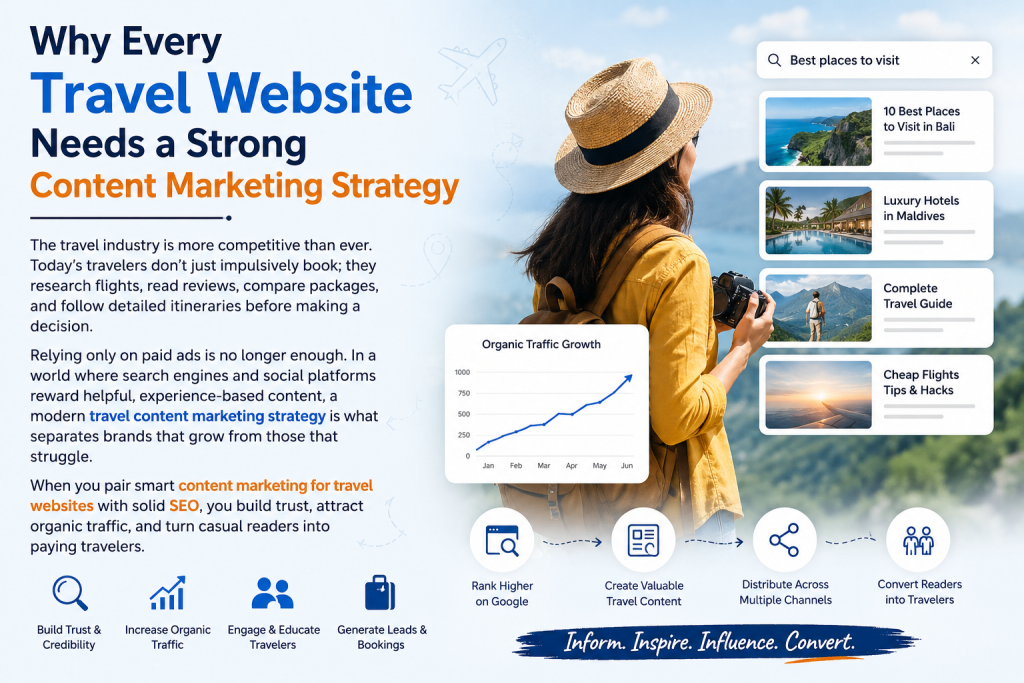
A strong travel content marketing strategy helps your website appear during these searches, giving your brand visibility before competitors even enter the conversation.
For example:
- A traveler searching for “Best beaches in Thailand” may discover your travel blog.
- Someone researching “7-day Italy itinerary” may land on your website.
- A family planning a vacation may read your travel tips before booking their tour package.
Content becomes the bridge between search intent and conversion.
Types of Travel Content That Perform Best
Some formats consistently outperform others in travel SEO and engagement:
- Destination guides – Comprehensive overviews of where to stay, what to do, and how much it costs.
- Travel itineraries – Day‑by‑day plans that reduce decision fatigue.
- SEO blogs – Posts that answer long‑tail questions like “best family‑friendly tour in Bali” or “budget travel tips for Europe.”
- Local experiences – Stories about hidden gems, homestays, food tours, and cultural activities.
- Videos – Reels, vlogs, and short‑form clips that show destinations in motion.
- User‑generated content – Photos, reviews, and testimonials from real customers.
- Email newsletters – Sequences that warm up leads and promote seasonal offers and packages.
Why Content Marketing Is Essential for Travel Websites
Travelers Start Their Journey on Search Engines
Most travel decisions begin with Google searches. Travelers want answers, inspiration, and guidance before making purchases.
Without SEO-focused content, your travel website may never appear in search results.
That’s where content marketing for travel websites becomes critical. By publishing optimized travel content, your site can rank for valuable keywords and attract targeted visitors consistently.
For example, ranking for searches like:
- “Best honeymoon destinations”
- “Affordable Europe trips”
- “Things to do in Bali”
- “Adventure tours in Nepal”
can generate thousands of monthly visitors organically.
Content Builds Trust Before Booking
Travel is a high-trust purchase. People spend significant amounts of money and want confidence before making decisions.
Helpful content builds that confidence.
When travelers read:
- Detailed destination guides
- Honest travel advice
- Expert recommendations
- Real travel experiences
They begin trusting your brand.
Trust is especially important because Google now prioritizes EEAT:
- Experience
- Expertise
- Authoritativeness
- Trustworthiness
Travel websites that consistently publish useful, experience-driven content often perform better in search rankings.
Content Generates Long-Term Organic Traffic
Paid advertising stops producing results the moment you stop spending money.
Content marketing works differently.
A single well-optimized article can drive traffic for months or even years.
For example:
- A destination guide published today may continue ranking for years.
- An evergreen itinerary can consistently attract search traffic.
- Travel comparison blogs can repeatedly generate leads.
This long-term value makes content one of the highest ROI marketing channels for travel businesses.
Content Improves Conversion Rates
Content not only attracts visitors but also helps convert them into customers.
Educational travel content reduces uncertainty and moves readers through the buyer journey.
For example:
- Blog posts introduce travelers to destinations
- Comparison articles help evaluate options
- Testimonials and case studies build confidence
- Booking pages close the sale
A strategic travel content marketing strategy guides readers naturally from discovery to booking.
Travel Content Marketing Trends in 2026
AI‑Assisted Travel Planning
AI chatbots and planning tools are helping travelers research and compare faster. Brands that create content optimized for AI summaries win more visibility and clicks.
Video‑First Content
Short‑form video on TikTok, Instagram Reels, and YouTube Shorts is now a primary discovery channel. Travel brands that publish regularly see higher engagement and follower growth.
Experience‑Based Storytelling
Authentic experiences beat generic descriptions. Travelers respond to stories about local hosts, hidden gems, and cultural moments, not just “what to see.”
Hyper‑Personalized Content
Recommendation engines and segmentation allow brands to deliver personalized itineraries and offers based on behavior, season, and interests.
Voice and Conversational Search
People increasingly search using natural language (“best family‑friendly beach in Asia”) and voice assistants. Travel sites that optimize for conversational queries and FAQs gain an edge.
How BlogWriting.Services Help Travel Websites Grow
If handling research, writing, and SEO in‑house feels overwhelming, professional support can bridge the gap. Here’s how BlogWriting.Services align with a strong travel content marketing strategy:
SEO‑Optimized Travel Blog Writing
- Deep keyword research for destination and transactional queries.
- Search‑intent optimization for each post.
- Clear on‑page SEO structure (headings, meta elements, internal links).
High‑Quality Travel Content Creation
- Expertly written destination articles, tourism blogs, and travel guides.
- Conversion‑focused writing that balances storytelling and clear CTAs.
- Content tailored to your audience and brand voice.
Consistent Content Publishing
- Scalable content production so you don’t have to stop and start.
- Editorial calendars that keep your content marketing for travel websites organized and predictable.
Human + SEO + AI Optimization
- EEAT‑focused writing that builds trust and authority.
- AI‑friendly formatting (structured headings, clear answers) that works well in AI‑generated results.
- Engaging storytelling that keeps readers engaged and browsing longer.
Content Designed to Increase Traffic and Bookings
By combining SEO, storytelling, and user intent, BlogWriting.Services help travel websites:
Design posts that naturally guide readers toward booking pages. Rank higher on Google, improve organic traffic and engagement
Step‑By‑Step Travel Content Marketing Plan
- Define your audience – Who are your ideal travelers?
- Research keywords – Identify destination, intent, and long‑tail queries.
- Build topic clusters – Group related content around core destinations and services.
- Create a content calendar – Plan topics, formats, and publishing dates.
- Optimize for SEO – Use clear headings, keywords, images, and internal links.
- Promote content – Share across blogs, social platforms, and email.
- Track analytics – Monitor traffic, engagement, and conversions.
- Update old content regularly – Refresh prices, offers, and details to maintain rankings.
Common Travel Content Marketing Mistakes to Avoid
- Publishing thin content with little value beyond surface information.
- Ignoring SEO and writing only for humans.
- Writing without understanding the search intent behind each keyword.
- Never update old blogs that may have outdated prices or links.
- Over‑promoting and selling instead of educating and inspiring.
- Posting inconsistently, which weakens topical authority and trust.
The travel industry is more competitive than ever, and relying solely on ads is no longer enough.
A strong travel content marketing strategy helps travel businesses:
- Increase organic traffic
- Build authority
- Improve trust
- Generate qualified leads
- Increase bookings
High-quality content marketing for travel websites creates long-term visibility that compounds over time.
If you want to scale your travel website with professionally written SEO content, BlogWriting.Services can help you create and optimize
FAQs
What is a travel content marketing strategy?
A travel content marketing strategy is a planned approach to creating and publishing content that attracts, engages, and converts travelers through blogs, guides, videos, and other formats.
Travelers research extensively before booking. Content answers their questions, builds trust, supports SEO, and guides them toward booking pages, improving both traffic and conversions.
Most successful travel brands publish 1–2 high‑quality posts per week or, at a minimum, maintain a consistent, predictable schedule aligned with a content calendar.
Destination guides, itineraries, budget breakdowns, comparison posts, and experience‑based stories tend to perform best for travel SEO and engagement.
Yes. Professional services streamline keyword research, creation, and SEO optimization, allowing travel brands to scale content and improve rankings without over‑stretching internal resources.
BlogWriting.Services help travel websites by producing SEO‑optimized, high‑quality blog content, maintaining consistency, and crafting material designed to increase traffic, engagement, and bookings.
