Complete Guide to Topic-Based Rankings
Publishing educational content is easier than ever, but ranking it is becoming increasingly difficult. Thousands of blogs, course pages, and learning resources are created daily, yet only a small percentage gain consistent visibility on Google. The difference often lies not in effort, but in how well the content is structured and understood by search engines.
Search engines have evolved beyond simple keyword matching. They now evaluate meaning, relationships between topics, and how well content answers a broader set of user queries. Educational websites that still rely only on keywords often struggle to compete in this environment.
Semantic SEO for educational content focuses on building context, connecting ideas, and covering topics comprehensively. It helps search engines understand your content better while delivering more value to users.
What Is Semantic SEO in Educational Content
Semantic SEO is the process of optimizing content based on meaning, context, and relationships between topics instead of relying only on exact keywords. It ensures that your content aligns with how search engines interpret information.
Semantic SEO vs Traditional SEO
Traditional SEO focuses on targeting specific keywords and optimizing pages around them. Semantic SEO expands this approach by including related terms, concepts, and questions to provide a complete understanding of a topic.
How Google Understands Educational Content
Search engines analyze entities, context, and relationships between topics. Instead of looking at isolated keywords, they evaluate how well your content connects different concepts and answers related queries.
Why Semantic SEO Matters for Educational Websites
Educational content is naturally complex and interconnected. Topics often overlap, and users expect comprehensive answers rather than fragmented information. Without a semantic approach, your content may appear incomplete or less relevant.
Semantic SEO helps educational websites build authority by covering topics in depth and connecting related ideas. This improves both rankings and user experience over time.
- Improves relevance
- Enhances rankings
- Builds authority
- Supports topic coverage
- Improves user experience
Understanding Entities and Topic Relationships
Entities are the building blocks of semantic SEO. They represent real-world concepts such as subjects, topics, or ideas that search engines can recognize and connect.
What Are Entities in SEO
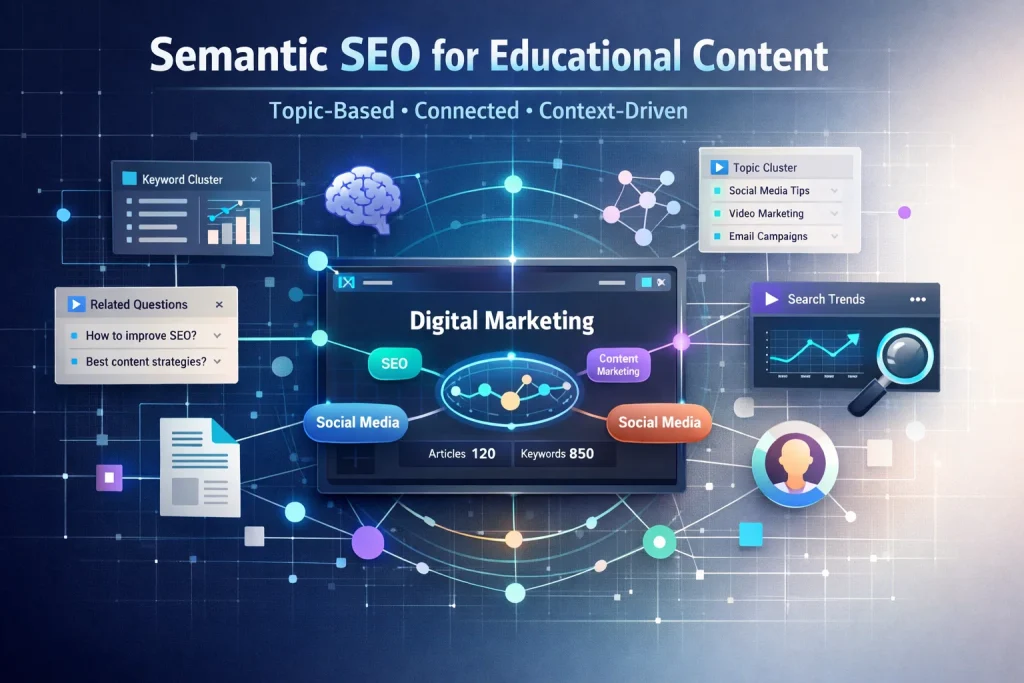
Entities help search engines understand what your content is about beyond keywords. For example, a topic like digital marketing includes entities such as SEO, content marketing, and social media.
How Topics Are Connected
Topics are connected through logical relationships. When your content clearly links related ideas, it signals depth and expertise, making it more valuable in search results.
Keyword Clustering for Educational Content
Keyword clustering involves grouping related keywords into a single topic. Instead of creating separate pages for each keyword, you build comprehensive content that covers multiple related queries.
This approach allows educational websites to rank for a wider range of keywords while maintaining content quality. It also supports semantic search optimization by providing broader context.
Building Topic Clusters for Education Websites
Topic clusters are a structured way of organizing content around a central theme. They help search engines understand the hierarchy and relationships between different pieces of content.
A strong cluster strategy ensures that your website covers a topic thoroughly while maintaining clear connections between pages.
- Create pillar content
- Add supporting articles
- Link content internally
- Cover subtopics
- Maintain hierarchy
Content Depth vs Breadth in Educational SEO
Educational content must balance depth and breadth. Depth ensures that a topic is explained thoroughly, while breadth ensures that related topics are also covered.
Focusing only on depth can limit your reach, while focusing only on breadth can reduce content quality. A balanced approach helps build topical authority and improves overall SEO performance.
Optimizing Content for Semantic Search
Optimizing for semantic search means structuring your content to answer multiple related queries and provide a complete understanding of the topic. It is about clarity, relevance, and depth.
Well-optimized content improves user experience and increases the likelihood of ranking for multiple keywords.
- Use related terms
- Answer multiple queries
- Improve structure
- Add FAQs
- Use clear headings
Role of Internal Linking in Semantic SEO
Internal linking is essential for connecting content and reinforcing relationships between topics. It helps search engines navigate your website and understand how different pages relate to each other.
A strong internal linking strategy improves both crawlability and user experience, making your content more accessible and valuable.
- Connect related topics
- Use descriptive anchors
- Link pillar and cluster pages
- Improve crawlability
- Strengthen authority
Using Schema Markup for Educational Content
Schema markup provides structured data that helps search engines better understand your content. It enhances how your pages appear in search results and supports semantic SEO.
FAQ Schema
FAQ schema allows common questions to appear directly in search results, improving visibility.
Article Schema
Article schema helps search engines identify blog content and understand its structure.
Course Schema
Course schema is especially useful for educational websites, providing detailed information about courses.
Common Semantic SEO Mistakes
Many educational websites fail to implement semantic SEO effectively due to common mistakes. These issues often limit the potential of their content.
Avoiding these mistakes ensures that your strategy delivers better results.
- Keyword-only focus
- Poor content structure
- No clustering
- Weak internal linking
- Ignoring intent
Step-by-Step Semantic SEO Strategy
A structured approach is essential for implementing semantic SEO effectively. Without a clear process, it becomes difficult to build consistency and achieve long-term results.
Following a step-by-step strategy helps you organize your content and improve performance systematically.
- Choose topic
- Research keywords
- Build clusters
- Optimize content
- Monitor performance
Final Thoughts on Semantic SEO for Educational Content
Semantic SEO is no longer optional for educational websites. It is a necessary approach to compete in modern search environments where context and meaning matter more than ever.
By focusing on topic relationships, content depth, and structured optimization, you can create educational content that ranks better, engages users, and builds long-term authority.
FAQs
1. What is semantic SEO?
Semantic SEO is the process of optimizing content based on meaning, context, and relationships between topics.
2. How is semantic SEO different from traditional SEO?
It focuses on topic coverage and context rather than just keywords.
3. Why is semantic SEO important for educational content?
Because it helps search engines understand complex topics and improves rankings.
4. What are topic clusters in SEO?
They are groups of related content connected around a central topic.
5. How does internal linking help semantic SEO?
It connects content and strengthens relationships between topics.
6. What is keyword clustering?
It is the process of grouping related keywords into a single topic.
7. How long does semantic SEO take to work?
It usually takes a few months depending on content quality and competition.