Build Authority and Rank Higher
Publishing travel blogs consistently does not guarantee rankings anymore. Many websites create dozens of articles about destinations, tips, and itineraries, yet struggle to gain visibility in search results. The problem is not always content quality, but the lack of structure behind that content.
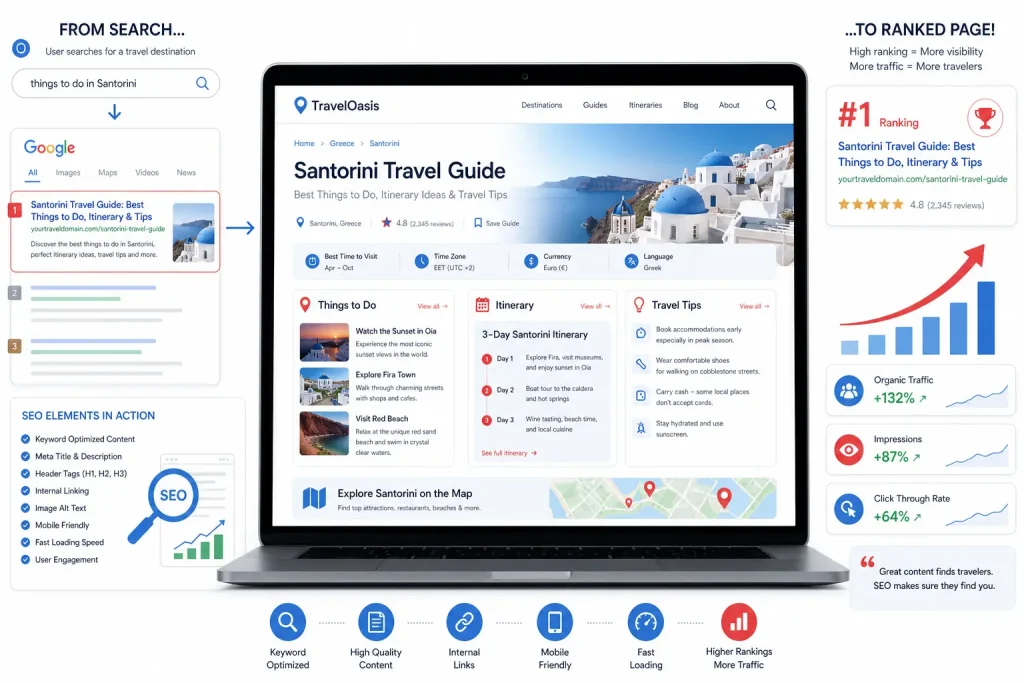
When users search for queries like “Thailand travel guide,” “things to do in Dubai,” or “Europe itinerary,” search engines prefer websites that demonstrate clear expertise and organization. Random, disconnected articles fail to compete with well-structured content ecosystems.
A pillar page strategy for travel SEO solves this problem by organizing your content into a structured system. It helps search engines understand your website better while guiding users through a complete journey, ultimately improving rankings and building long-term authority.
What Is a Pillar Page in Travel SEO
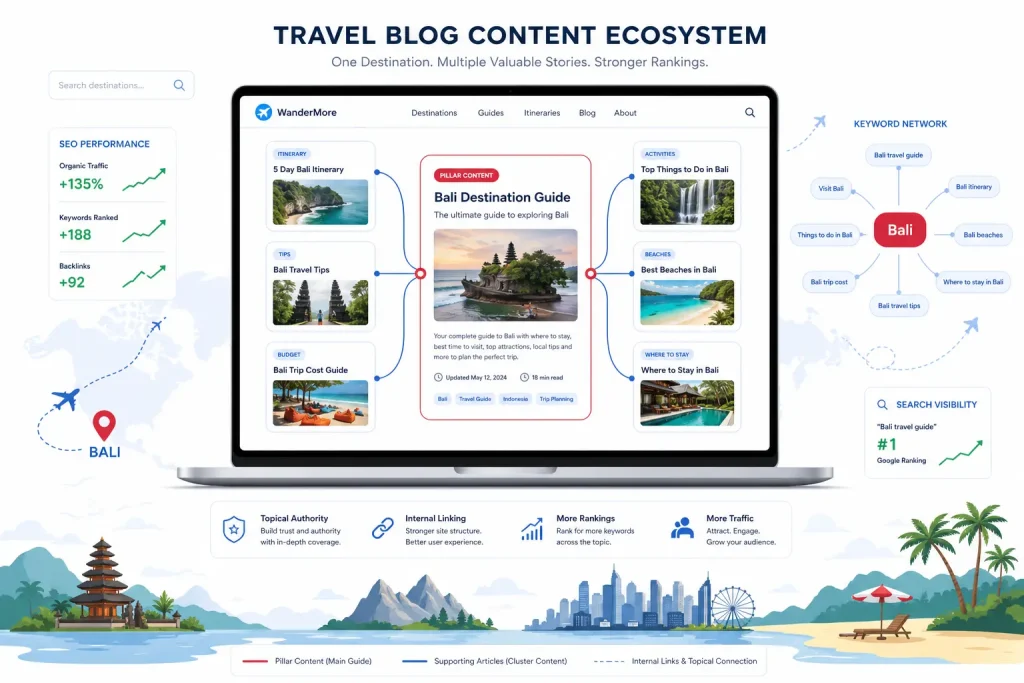
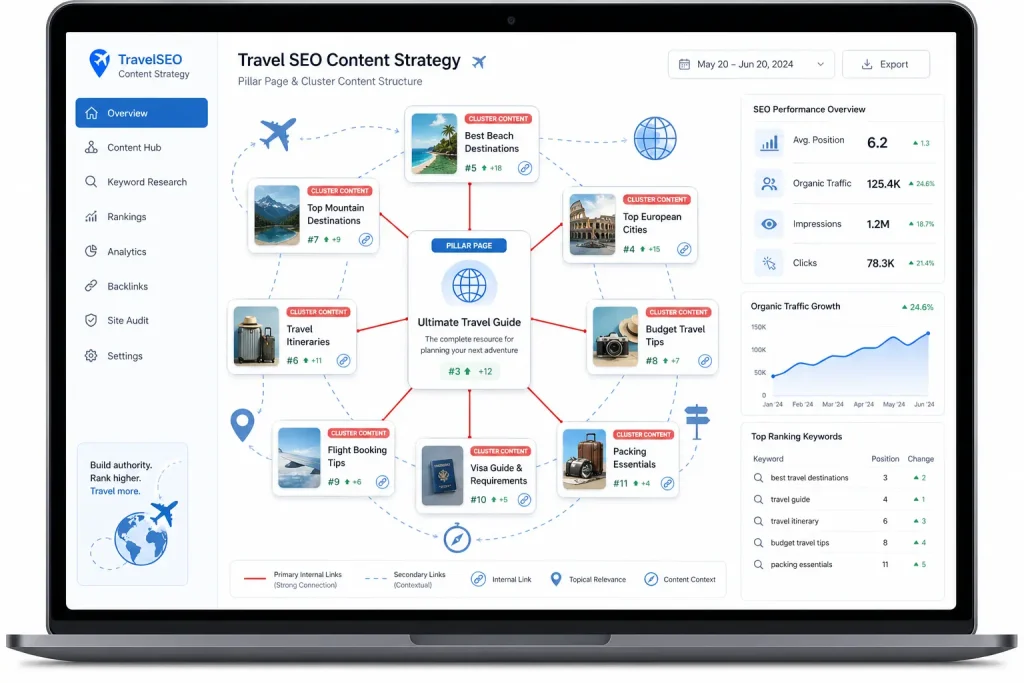
A pillar page is a comprehensive piece of content that covers a broad travel topic and links to more detailed supporting articles. It acts as the central hub of a topic cluster.
Pillar Pages vs Blog Posts
Blog posts usually focus on specific queries or subtopics, while pillar pages provide an overview of an entire subject and connect multiple related posts.
Role of Pillar Pages in Travel Websites
Pillar pages help organize your website, improve navigation, and signal topical authority to search engines. They are essential for building a scalable travel SEO strategy.
Why Pillar Page Strategy Matters for Travel SEO
The travel niche is highly competitive, with large websites dominating search results. Without a clear structure, even high-quality content struggles to perform because search engines cannot easily understand its relevance.
A pillar page strategy creates a strong foundation by connecting all related content under a central topic. This improves both user experience and SEO performance.
- Improves rankings
- Builds topical authority
- Enhances user experience
- Supports internal linking
- Drives long-term traffic
Keyword Research and Topic Mapping for Travel Pillar Pages
Keyword research is the starting point of any pillar page strategy. It helps you identify which topics to target and how to organize your content effectively.
Mapping keywords into structured topics ensures that your content covers all important aspects of a subject.
Destination-Based Topics
These include location-focused topics like “Bali travel guide” or “Paris itinerary.”
Travel Theme Topics
These focus on specific interests such as budget travel, luxury travel, or adventure travel.
Long-Tail Keyword Mapping
Long-tail keywords help you create supporting content that addresses specific user queries and improves overall coverage.
Creating Effective Pillar Pages for Travel Websites
A successful pillar page needs to be comprehensive, well-structured, and user-friendly. It should provide an overview while guiding users to more detailed content.
The goal is to create a resource that covers a topic completely while remaining easy to navigate.
- Comprehensive coverage
- Clear structure
- Broad keyword targeting
- Easy navigation
- Internal linking
Building Supporting Content Clusters
Supporting content clusters expand on the main topic of your pillar page. These articles target specific subtopics and long-tail keywords.
Together, pillar pages and clusters create a strong content ecosystem that improves rankings and user engagement.
- Blog posts
- Sub-guides
- Activity-based content
- Seasonal content
- Niche topics
Internal Linking Strategy for Pillar Pages
Internal linking is a critical part of pillar page strategy. It connects your content and helps search engines understand the relationship between different pages.
A strong linking structure improves navigation and distributes authority across your website.
- Link clusters to pillar
- Use keyword-rich anchors
- Create logical structure
- Improve crawlability
- Distribute authority
Content Depth and Structure Optimization
Content depth is essential for pillar pages. A shallow page cannot compete in the travel niche. Your pillar page should provide a complete overview of the topic while linking to detailed subtopics.
Structure is equally important. Use clear headings, sections, and formatting to make your content easy to read and navigate. This improves both user experience and SEO performance.
Semantic SEO and Topical Relevance
Semantic SEO plays a key role in building effective pillar pages. It ensures that your content is optimized for context and meaning rather than just keywords.
By covering related topics and using natural language, you improve the overall relevance of your content.
- Use related keywords
- Cover subtopics
- Improve context
- Increase relevance
- Strengthen authority
Common Mistakes in Pillar Page Strategy
Many travel websites fail to benefit from pillar pages because they do not implement the strategy correctly. Mistakes in structure or execution can limit results.
Understanding these issues helps you avoid common pitfalls and build a stronger SEO foundation.
- Thin pillar pages
- Weak internal linking
- Poor keyword mapping
- No content clusters
- Inconsistent publishing
Step-by-Step Pillar Page Strategy for Travel SEO
Building a pillar page strategy requires planning and consistency. Without a clear process, it becomes difficult to scale your content effectively.
A structured approach ensures that every piece of content contributes to your overall SEO goals.
- Choose a main topic
- Build a pillar page
- Create supporting clusters
- Interlink content
- Update regularly
Final Thoughts on Travel Content Strategy
A pillar page strategy for travel SEO is one of the most effective ways to build authority and improve rankings. It transforms scattered content into a structured system that benefits both users and search engines.
By focusing on keyword mapping, content clusters, internal linking, and semantic SEO, you can create a travel website that ranks consistently and attracts high-quality traffic. Over time, this approach helps establish your site as a trusted resource in the travel niche.
FAQs
1. What is a pillar page in travel SEO?
A pillar page is a comprehensive guide that covers a broad topic and links to related content.
2. How to create pillar pages for travel blogs?
By choosing a main topic, creating detailed content, and linking supporting articles.
3. What are topic clusters in travel SEO?
They are groups of related content connected to a central pillar page.
4. How does internal linking help pillar pages?
It improves navigation and helps distribute authority across pages.
5. How long does it take to see results?
It can take a few months depending on consistency and competition.
6. What is the best structure for travel SEO?
A structured approach using pillar pages and content clusters works best.
7. Do pillar pages improve rankings?
Yes, they improve topical authority and overall SEO performance.