If you run a plumbing company, you already know how competitive your market is.
When someone searches “emergency plumber near me” or “water heater repair in Dallas,” they’re not browsing — they’re ready to call. And if your website isn’t ranking on page one, those calls are going straight to your competitors.
That’s exactly why On Page SEO for Plumbers is critical. It helps your website show up for high-intent searches, generate consistent leads, and reduce your dependence on expensive paid platforms like Angi or HomeAdvisor.
In this guide, I’ll break down a complete plumbing SEO framework you can use to rank higher and increase inbound calls.
Why On Page SEO Is Critical for Plumbing Companies
Plumbing is one of the most competitive local service industries in the United States. In most cities, dozens — sometimes hundreds — of contractors are fighting for the same search terms.
Paid ads can generate leads quickly, but the cost per lead in plumbing can be extremely high. SEO, on the other hand, builds long-term visibility. Once you rank organically, you continue receiving calls without paying per click.
Strong on-page SEO for plumbing companies helps you:
- Rank for high-intent service keywords
- Appear in local search results
- Increase inbound phone calls
- Generate consistent form submissions
- Build trust with homeowners
Without proper on-page optimization, even a well-designed plumbing website will struggle to compete.
Keyword Research for Plumbing SEO
Before you optimize any page, you need to understand how customers search for plumbing services. Plumbing searches are highly intent-driven and usually tied to specific services and locations.
Most homeowners don’t search for “plumbing company.” They search for very specific problems. That’s why your keyword strategy must align with real-world demand.
Your plumbing SEO keyword research should focus on:
- Service-based keywords (e.g., drain cleaning, water heater repair, pipe leak repair)
- Emergency keywords (e.g., 24-hour plumber, emergency plumber near me)
- Location-based keywords (e.g., plumber in Houston, plumbing services in Phoenix)
- Problem-based searches (e.g., clogged toilet fix, low water pressure repair)
Combining service + location + intent is what makes plumber website optimization effective.
Optimizing Core Plumbing Website Pages
A plumbing website usually has several important pages. Each page should target a specific keyword group and serve a clear purpose.
You should never rely on one generic “Services” page to rank for everything. That’s a common mistake that limits visibility.
Homepage Optimization
Your homepage should target your primary location and main plumbing service category. It should clearly communicate what you do and where you operate.
Before you think about adding keywords, make sure your homepage:
- Has a clear H1 with your main keyword
- Mentions your primary service areas naturally
- Highlights emergency availability if applicable
- Includes trust signals (licenses, certifications, reviews)
- Links to individual service pages
The homepage should build authority while directing users deeper into your site.
Service Pages Optimization
Service pages are the backbone of plumbing SEO. Each major service should have its own dedicated page.
For example, you should have separate pages for drain cleaning, water heater repair, sewer line repair, and pipe replacement. This allows you to rank for highly specific searches.
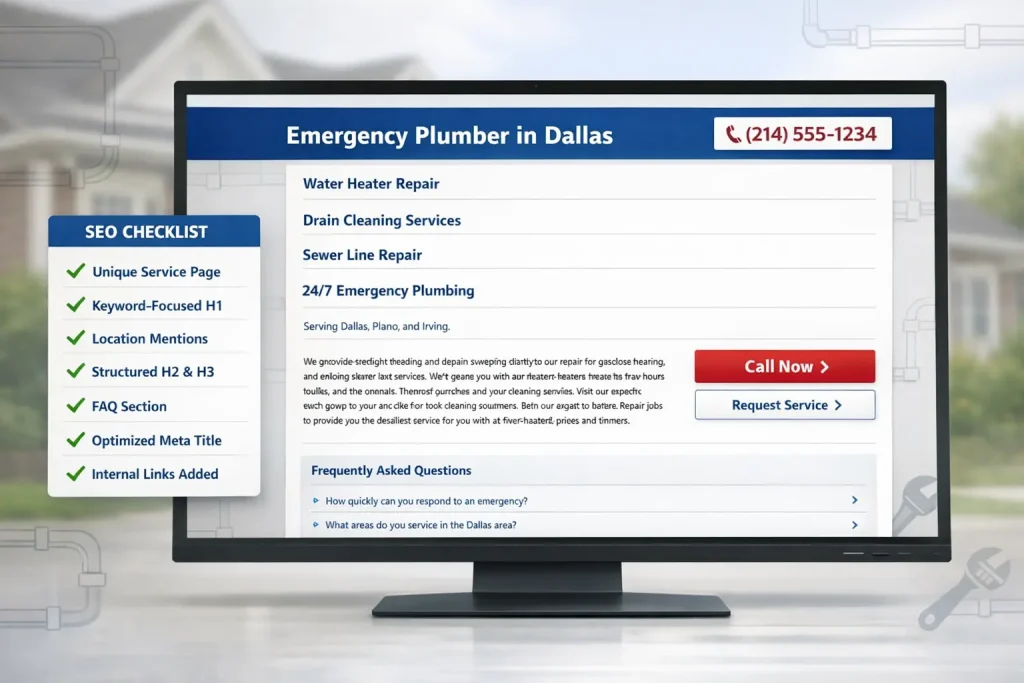
A properly optimized plumbing service page should include:
- A keyword-focused H1
- 500–800 words of detailed service explanation
- Common problems and solutions
- Service area mentions
- Clear call-to-action buttons
Avoid copying and pasting similar descriptions across service pages. Unique, helpful content wins.
City / Location Pages
If you serve multiple cities or neighborhoods, location pages are essential. These pages allow you to rank for “plumber in [city]” searches.
However, location pages must be handled carefully. Thin, duplicate city pages can hurt rankings.
An effective city page should include:
- A unique introduction for that location
- Mention of local neighborhoods or landmarks
- Services offered in that city
- Testimonials from local customers
- Internal links to relevant service pages
When done properly, city pages can dramatically increase local SEO for plumbers.
Contact Page Optimization
Your contact page plays a major role in conversion-focused SEO. Many plumbing companies overlook this page from an optimization standpoint.
While it may not be your primary ranking page, it must be highly functional and clear.
An optimized contact page should include:
- Click-to-call phone numbers
- Clear business hours
- Embedded Google Map
- Service area list
- Mobile-friendly form
A confusing contact page can reduce conversions even if your traffic is strong.
Title Tags & Meta Descriptions for Plumbers
Title tags are one of the most powerful on-page ranking factors. For plumbing companies, they must clearly include the service and location.
Instead of generic titles like “Home,” your titles should look like:
- Emergency Plumber in Dallas | 24/7 Plumbing Services
- Water Heater Repair in Phoenix | Licensed Plumbers
Meta descriptions should focus on urgency, reliability, and trust. While they don’t directly impact rankings, they strongly influence click-through rates.
A well-written title and description combination increases both visibility and calls.
Content Optimization for Plumbing Websites
Many plumbing websites are too thin on content. A few paragraphs are rarely enough to rank in competitive markets.
Google wants detailed, helpful content that answers user questions and demonstrates expertise.
Proper content optimization for plumbing website SEO includes:
- One clear H1 per page
- Structured H2 and H3 headings
- Natural keyword placement
- Detailed service explanations
- FAQs about common plumbing issues
- Clear call-to-action placement
Avoid keyword stuffing. Instead, focus on clarity and helpful information.
Local SEO for Plumbers
Local SEO is critical in plumbing because nearly all searches are geographically driven. If someone’s pipe bursts, they search for a nearby contractor immediately.
Local signals help Google determine which plumbing company to show in the map pack.
To improve local SEO for plumbers, focus on:
- Optimizing your Google Business Profile
- Keeping NAP (Name, Address, Phone) consistent
- Encouraging customer reviews
- Adding local keywords throughout your site
- Embedding Google Maps on your website
Strong local signals increase your chances of appearing in both map results and organic listings.
Schema Markup for Plumbing Companies
Structured data helps search engines understand your business details more clearly.
While many plumbing companies ignore schema markup, it can improve how your website appears in search results.
Plumbing companies should consider implementing:
- LocalBusiness schema
- Service schema
- Review schema
- FAQ schema
Schema enhances visibility and can improve click-through rates.
Internal Linking Strategy for Plumbing Websites
Internal linking distributes authority across your website and helps search engines understand your structure.
Instead of random linking, create a clear system that connects related services and locations logically.
An effective internal linking strategy should include:
- Linking service pages from the homepage
- Connecting city pages to service pages
- Linking blog posts to relevant services
- Using descriptive anchor text
- Avoiding over-optimized anchors
Good internal linking improves rankings and user navigation.
Common On Page SEO Mistakes Plumbers Make
Many plumbing companies struggle with SEO because of avoidable mistakes.
Some of the most common issues include:
- Only having one generic services page
- Thin city pages with duplicate content
- No structured headings
- Slow website speed
- Missing schema markup
- Poor mobile optimization
- Over-reliance on paid lead platforms
Fixing these problems alone can significantly improve search visibility.
On Page SEO Checklist for Plumbers
To simplify everything, here’s a practical action checklist you can follow:
- Conduct service + location keyword research
- Create dedicated service pages
- Build unique city pages
- Optimize title tags and meta descriptions
- Improve page speed
- Implement schema markup
- Strengthen internal linking
- Optimize Google Business Profile
- Add conversion-focused CTAs
Consistency and execution determine long-term success.
Conclusion
On Page SEO for Plumbers is not just about rankings — it’s about calls.
When your plumbing website is properly optimized, you show up for high-intent searches at the exact moment customers need help.
With structured service pages, strong local SEO, optimized content, and technical improvements, your plumbing company can compete — even in crowded markets.
SEO is not instant, but when executed correctly, it becomes one of your most reliable and profitable lead generation channels.
FAQs About On Page SEO for Plumbers
1. How do plumbers rank higher on Google?
By optimizing service pages, building strong location pages, improving local SEO signals, and enhancing website speed.
2. Is SEO worth it for plumbing companies?
Yes. SEO provides long-term, cost-effective lead generation compared to expensive paid platforms.
3. How long does plumbing SEO take?
Most plumbing companies see noticeable improvements within 3–6 months, depending on competition.
4. Should plumbers create blog content?
Yes. Blog posts targeting common plumbing problems help increase organic traffic and authority.
5. Does local SEO really matter for plumbers?
Absolutely. Plumbing is highly location-driven, making local SEO essential for visibility.