If you run a finance website, you already know something important — this niche is not like others.
Whether you’re offering investment advice, financial planning, loans, insurance, or fintech tools, you’re operating in a YMYL (Your Money Your Life) category. That means Google treats your content with extra scrutiny. Rankings are harder to earn. Authority takes longer to build. And weak content simply won’t survive.
That’s exactly why on page SEO for finance website is not optional — it’s foundational.
In this guide, I’ll break down how to optimize your finance website the right way — strategically, ethically, and in a way that builds both rankings and trust.
Why On Page SEO Is Critical for Finance Websites
Finance is one of the most competitive industries online. You’re not just competing with small blogs. You’re competing with banks, fintech giants, investment platforms, and established media publications.
On top of that, Google applies stricter quality evaluation standards to finance content. This means basic keyword stuffing or thin blog posts won’t help you rank.
Here’s why on-page SEO matters more in finance:
- Competition is extremely high
- Google applies YMYL standards
- Trust signals heavily influence rankings
- Content must demonstrate real expertise
- Authority is built page-by-page
Unlike trend-based industries, finance SEO is a long-term strategy. The stronger your on-page foundation, the easier it becomes to build domain authority over time.
Understanding YMYL & E-E-A-T in Finance SEO
Before you optimize anything, you must understand one thing: Google cares deeply about credibility in finance.
YMYL (Your Money Your Life) refers to content that impacts a person’s financial stability, health, or safety. Finance websites fall directly under this category.
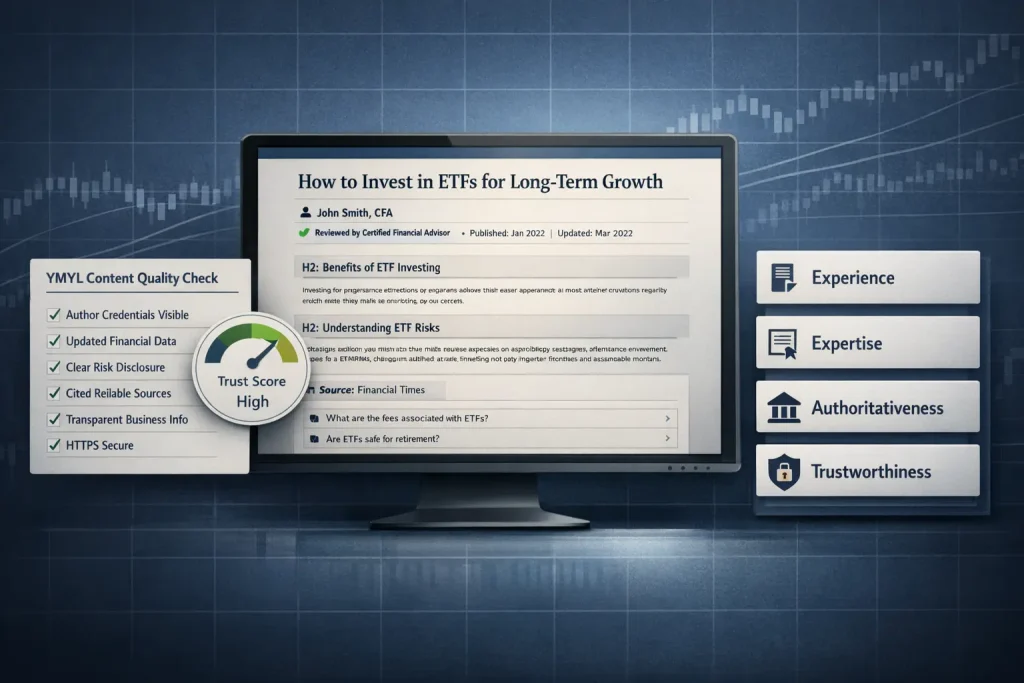
E-E-A-T stands for:
- Experience
- Expertise
- Authoritativeness
- Trustworthiness
For finance websites, these signals aren’t “nice to have.” They’re ranking factors in practice.
To strengthen E-E-A-T on your finance website:
- Publish content written or reviewed by qualified professionals
- Add detailed author bios with credentials
- Cite reliable financial sources
- Keep content updated with current data
- Display clear contact and business information
If Google cannot trust your financial advice, it will not rank your pages — no matter how good your keyword optimization is.
Keyword Research for Finance Website SEO
Keyword research for finance websites requires more precision than most niches. You’re not just looking for traffic — you’re looking for intent.
Different users search for financial information at different stages:
- Early research (informational intent)
- Comparison (commercial intent)
- Ready to act (transactional intent)
Your strategy must map content to each stage.
Focus on:
- Informational keywords (e.g., “how to invest in ETFs”)
- Commercial keywords (e.g., “best robo advisors 2026”)
- Transactional keywords (e.g., “open high yield savings account”)
- Long-tail finance queries with clear intent
Instead of chasing broad keywords like “investing,” go deeper into specific, problem-solving search queries. Finance SEO rewards specificity and clarity.
Optimizing Core Pages on a Finance Website
Every finance website has a few critical page types that must be optimized differently. A blog page cannot be treated the same as a financial service landing page.
Let’s break them down properly.
Homepage Optimization
Your homepage sets the tone for authority and trust. It should clearly communicate:
- Who you are
- What financial services you provide
- Who you help
- Why you’re credible
Best practices:
- Include your primary keyword naturally
- Add trust badges or certifications
- Highlight core services with internal links
- Display contact information clearly
- Include a short authority-building section
Avoid clutter. Finance websites must look clean, professional, and credible.
Service Pages (Loans, Investments, Advisory, etc.)
Service pages are your money pages. These must balance SEO with compliance and clarity.
Strong finance service pages should:
- Clearly explain the service in simple terms
- Outline benefits and risks (important for trust)
- Use structured H2 and H3 headings
- Include FAQs for search visibility
- Add calls-to-action that feel professional, not pushy
Thin service pages are one of the biggest ranking killers in finance SEO. Each page should be comprehensive and value-driven.
Blog / Resource Pages
Blog content builds authority and long-term organic traffic. But finance blogs must be more than surface-level summaries.
To optimize finance blog posts:
- Answer one clear financial question
- Use real-world examples
- Include updated statistics
- Structure content with clear headings
- Internally link to relevant service pages
The goal is to become a trusted educational resource — not just another blog chasing clicks.
Landing Pages for Financial Products
If you promote financial tools or fintech products, landing pages must combine SEO and conversion psychology.
These pages should:
- Clearly explain features
- Highlight security and compliance
- Include trust elements
- Address objections
- Use schema markup where relevant
Remember, finance users are skeptical — your page must reduce friction.
Title Tags & Meta Descriptions for Finance Sites
Title tags are extremely important in finance SEO because competition is intense.
Your titles should:
- Include the primary keyword
- Highlight benefit or clarity
- Avoid exaggerated promises
- Stay within 55–60 characters
Meta descriptions should:
- Be under 160 characters
- Encourage clicks naturally
- Reinforce trust
- Avoid misleading claims
In finance, credibility beats clickbait.
Content Optimization for Financial Websites
Content quality is where most finance websites fail.
You cannot publish generic, vague advice and expect rankings. Google evaluates content depth, structure, clarity, and expertise signals.
Strong finance content should:
- Use structured headings (H1, H2, H3 properly)
- Explain complex terms clearly
- Include real examples
- Avoid over-promising returns
- Be regularly updated
Financial misinformation is heavily penalized. Accuracy builds both rankings and brand reputation.
Trust Signals & Conversion-Focused SEO
Trust is not a design element — it’s an SEO factor in finance.
When optimizing your finance website, you must actively build credibility.
Important trust signals include:
- Detailed author bios
- Professional certifications
- Business registration details
- Secure HTTPS connection
- Clear privacy policy
- Transparent fee disclosures
The more transparent you are, the stronger your E-E-A-T profile becomes.
Schema Markup for Finance Websites
Structured data helps search engines understand your content better. In competitive finance SERPs, schema can give you visibility advantages.
Useful schema types include:
- Organization schema
- FinancialService schema
- FAQ schema
- Review schema
- Article schema
Proper schema can improve rich results, CTR, and credibility in search listings.
Internal Linking Strategy for Finance Websites
Internal linking is often underestimated in finance SEO.
Strategic internal linking:
- Distributes authority across your site
- Connects informational and transactional pages
- Improves crawlability
- Strengthens topical relevance
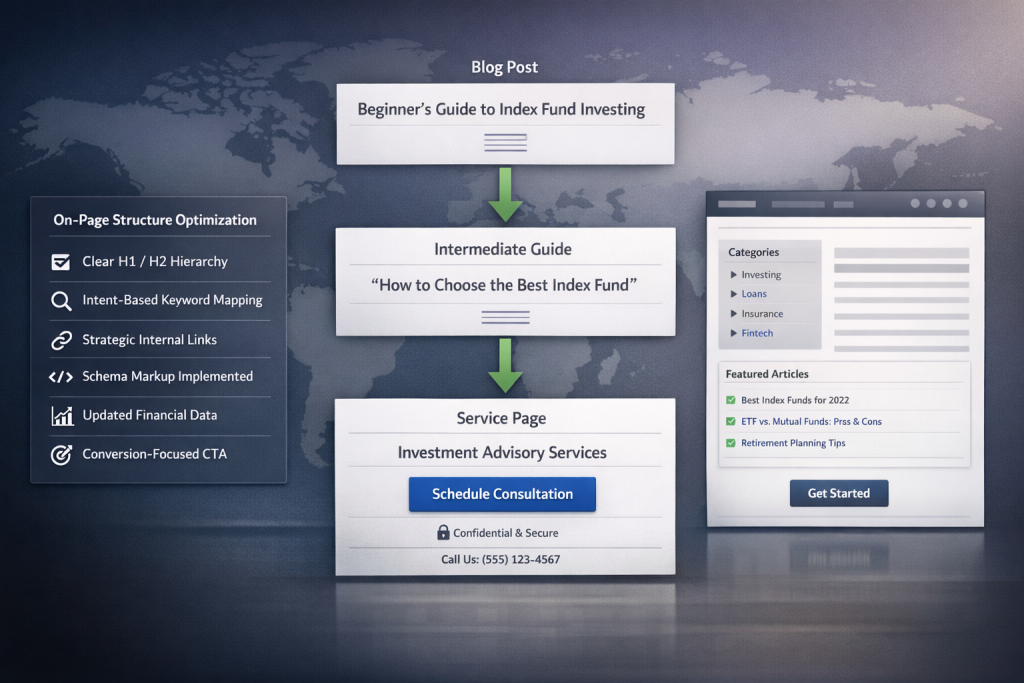
A strong structure might look like:
- Blog post → Related guide → Service page
- Beginner guide → Advanced guide → Product page
Think of internal links as your website’s financial roadmap.
Common On Page SEO Mistakes Finance Websites Make
Even established finance websites make critical on-page mistakes that hold back rankings.
The most common ones include:
- Thin or outdated content
- No visible author credentials
- Overuse of broad keywords
- Weak internal linking
- No schema implementation
- Lack of trust-building elements
Fixing these alone can significantly improve rankings.
On Page SEO Checklist for Finance Websites
Here’s a quick practical checklist you can apply immediately:
- Clear keyword targeting per page
- Strong title tag and meta description
- Proper heading hierarchy
- Author bio with credentials
- Updated financial data
- Schema markup implementation
- Strategic internal linking
- Transparent contact and policy pages
If your website meets these standards, you’re already ahead of many competitors.
Final Thoughts
On page SEO for finance website is not about shortcuts. It’s about structure, clarity, authority, and trust.
If you optimize your finance website with YMYL standards in mind, build real expertise signals, and structure your pages strategically, you can compete — even in one of the most difficult industries online.
Finance SEO rewards those who build credibility the right way.
FAQs
Is SEO harder for finance websites?
Yes. Finance falls under YMYL, which means Google applies stricter quality and trust evaluation standards compared to most niches.
What is the most important ranking factor for finance SEO?
E-E-A-T (Experience, Expertise, Authoritativeness, Trustworthiness) plays a major role, especially in financial content.
How long does finance SEO take to show results?
Because of high competition and trust requirements, finance SEO often takes 6–12 months for strong, stable results.
Should financial websites use schema markup?
Yes. Organization, FinancialService, FAQ, and Article schema can improve visibility and click-through rates.
Can small fintech startups rank against big banks?
Yes — but through niche targeting, strong on-page SEO, deep content, and consistent authority building.