Improve Rankings Fast
When users search for terms like “SEO agency near me,” “website design services,” or “digital marketing company,” they expect more than just relevant content. They expect a fast, smooth, and intuitive experience. If a website loads slowly, feels confusing, or is difficult to navigate, users leave almost instantly.
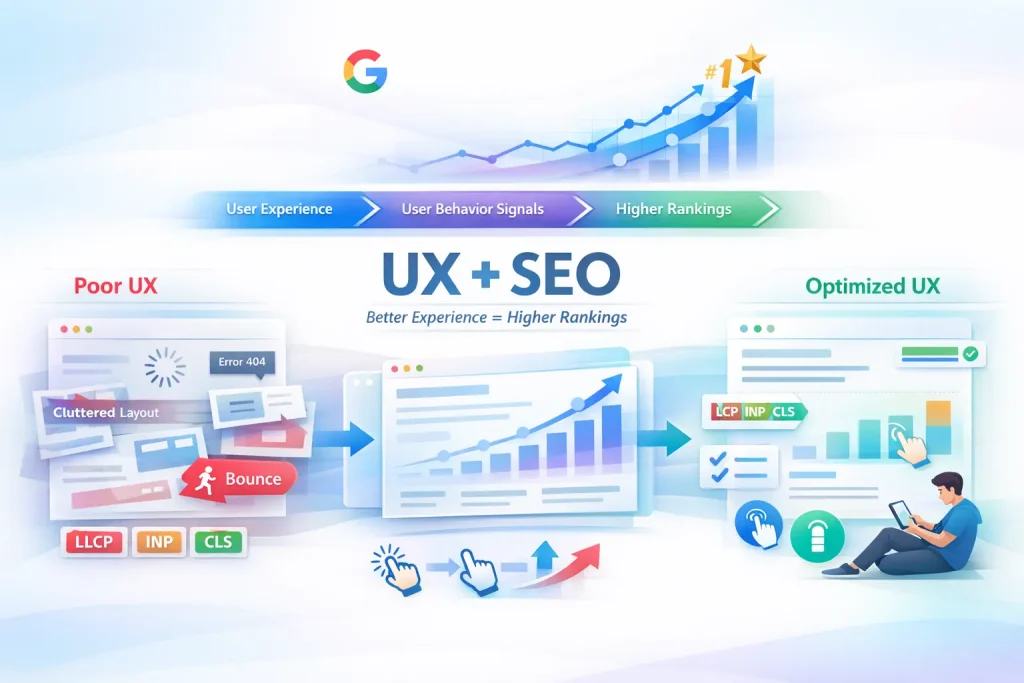
Search engines track these behaviors and use them as indicators of quality. This is where user experience (UX) and SEO become deeply connected. A website that delivers a strong user experience not only ranks higher but also converts visitors into customers more effectively.
What Is User Experience (UX) in SEO?
User experience in SEO refers to how users interact with your website, including how easy it is to navigate, how fast it loads, and how clearly the content is presented. It combines design, usability, and performance into a single experience that determines whether users stay or leave.
From an SEO perspective, UX is no longer optional. Search engines evaluate how users behave on your site, and these signals directly influence rankings. A well-optimized UX leads to better engagement, higher retention, and improved visibility.
Why UX Is Important for SEO Rankings
Search engines aim to deliver the best possible results to users. This means ranking websites that provide both relevant content and a seamless experience. If users consistently leave your site quickly, it signals that your content or experience is not meeting expectations.
A strong UX improves engagement metrics such as time on site and interaction rates. These signals help search engines understand that your website provides value, which can lead to higher rankings and better performance.
Key UX Factors That Impact SEO
Several UX elements directly affect how your website performs in search results. These factors influence both user satisfaction and search engine evaluation, making them critical for SEO success.
The most important UX factors for SEO include
- Page speed and performance
- Mobile-friendliness
- Website navigation
- Content readability
- Visual stability through Core Web Vitals
How User Behavior Signals Affect SEO

User behavior signals provide insight into how visitors interact with your website. Search engines use these signals to determine whether your content is useful and relevant to users.
Understanding and optimizing these signals can significantly improve your SEO performance.
The key behavior signals include
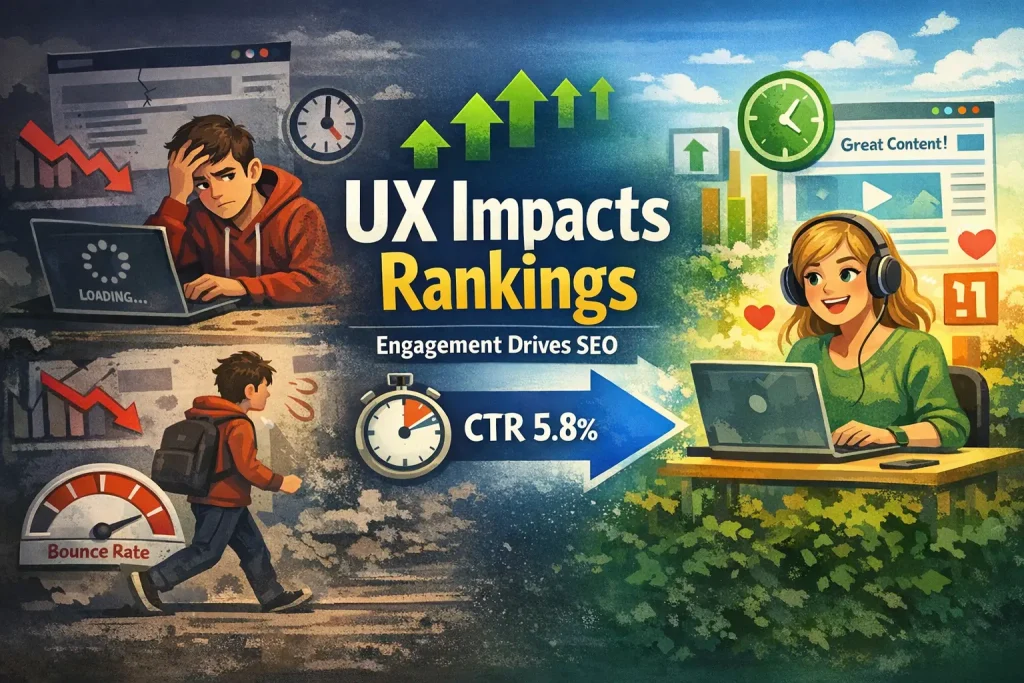
- Bounce rate, which indicates how quickly users leave your site
- Dwell time, which measures how long users stay on a page
- Click-through rate (CTR), which reflects how often users click your result
UX Optimization Strategies for SEO
Improving UX requires a combination of technical improvements, design enhancements, and content optimization. A structured approach ensures that your website meets both user expectations and search engine requirements.
The most effective UX optimization strategies include
- Improving page load speed through performance optimization
- Enhancing mobile experience with responsive design
- Simplifying navigation to help users find information quickly
- Improving content structure for better readability
- Reducing friction points that interrupt user journeys
UX and Internal Linking Strategy
Internal linking is a key component of both UX and SEO. It helps guide users through your website, making it easier to find relevant information while also helping search engines understand your content structure.
A well-planned internal linking strategy improves user flow and keeps visitors engaged for longer periods.
Key internal linking practices include
- Creating a logical content flow between pages
- Using contextual internal links within content
- Reducing navigation confusion with clear pathways
UX Optimization for AEO (Future SEO)
As search evolves toward AI-driven systems, user experience must also adapt. Answer Engine Optimization (AEO) requires content that is easy to read, well-structured, and optimized for quick understanding.
A strong UX ensures that both users and AI systems can easily interpret your content, increasing your chances of appearing in featured snippets and AI-generated answers.
Important AEO-focused UX strategies include
- Structuring content with clear headings and sections
- Improving readability for both users and machines
- Using semantic design to enhance content clarity
Common UX and SEO Mistakes
Many websites struggle with rankings due to poor user experience. These issues often go unnoticed but can significantly impact both engagement and SEO performance.
Avoiding these mistakes is essential for building a high-performing website.
Common UX and SEO mistakes include
- Slow loading pages that increase bounce rates
- Poor mobile design that frustrates users
- Confusing navigation that makes content hard to find
- Cluttered layouts that reduce readability
Final Thoughts
User experience and SEO are no longer separate strategies. They are interconnected elements that work together to determine your website’s success. A website that prioritizes UX not only ranks higher but also delivers better results in terms of engagement and conversions.
By focusing on performance, usability, and structured content, businesses can create a strong foundation for long-term SEO growth and competitive advantage.
FAQs about UX effect on SEO
What is UX in SEO?
User experience in SEO refers to how users interact with your website, including navigation, speed, and usability
How does user experience affect SEO rankings?
It influences user behavior signals such as bounce rate and dwell time, which impact rankings
What are Core Web Vitals?
They are performance metrics that measure loading speed, interactivity, and visual stability
How can I improve UX for SEO?
By improving page speed, mobile usability, navigation, and content structure
Does UX impact conversions?
Yes, a better user experience increases engagement and conversion rates
What is the relationship between UX and SEO?
UX improves user satisfaction, which leads to better SEO performance and rankings
Why is mobile UX important for SEO?
Because search engines use mobile-first indexing and prioritize mobile user experience