
Common E-commerce Blog Writing Mistakes to Avoid
E-commerce blogging is one of the most powerful digital marketing tools for online businesses in the USA. It helps brands attract organic traffic, build authority, and increase conversions without relying heavily on paid ads.
However, many e-commerce websites struggle to get results from blogging. The problem is not content creation itself, but the writing mistakes that limit SEO performance and user engagement.
In the competitive USA ecommerce market, even small content errors can affect rankings, reduce visibility, and lower sales. That is why understanding these mistakes is essential for long-term success.
At our ecommerce blog writing service, we help businesses fix these issues with SEO-focused, conversion-driven content strategies. In this guide, we will explain the most common e-commerce blog writing mistakes and how to avoid them using proven USA SEO practices.

Not Understanding Search Intent in USA E-commerce SEO
Search intent is the foundation of successful e-commerce blog writing. It defines what the user actually wants when they search on Google. If your content does not match intent, it will not perform well in the USA search results.
In e-commerce SEO, there are three main types of intent:
- Informational intent (users want to learn)
- Commercial intent (users are comparing options)
- Transactional intent (users are ready to buy)
Many e-commerce blogs fail because they mix these intents into a single article. This creates confusion for both users and search engines.
For example, if a user searches “best running shoes for flat feet USA,” they expect a comparison guide, not a direct sales page. Writing content that ignores this intent reduces engagement and ranking potential.
Why search intent matters for USA rankings
Google’s algorithm in the USA prioritizes user satisfaction. If users quickly leave your page, it signals low relevance. This leads to lower rankings.
Our writing process always starts with intent analysis. This ensures every blog matches exactly what USA users are searching for.
Weak Keyword Research Strategy for E-commerce Blogs
Keyword research is a critical part of e-commerce SEO success. Many websites fail because they rely on generic or highly competitive keywords.
In the USA market, competition is extremely high. Broad keywords like “shoes” or “laptops” are nearly impossible to rank for without authority.
Common keyword mistakes include
- Targeting only short-tail keywords
- Ignoring long-tail search queries
- Not considering buyer intent
- Poor keyword placement in headings
Instead, successful ecommerce blogs focus on long-tail keywords such as:
- Best waterproof hiking boots USA for winter
- affordable skincare routine for acne-prone skin USA
- Best budget laptops for college students in the USA
These keywords attract targeted traffic that is more likely to convert.
Our keyword strategy approach
At our company, we use advanced keyword clustering, competitor analysis, and USA search trend research. This helps us target keywords that not only bring traffic but also generate real sales opportunities.
Poor Content Structure and Readability
A well-structured blog improves both SEO performance and user experience. Unfortunately, many e-commerce blogs are written as long, unorganized blocks of text.
USA readers prefer content that is easy to scan and understand quickly.
A strong e-commerce blog structure should include:
- Clear H2 and H3 headings
- Short paragraphs with simple sentences
- Bullet points for clarity
- Logical flow from problem to solution
Why structure affects SEO performance
Google tracks how users interact with your content. If users stay longer, scroll more, and engage deeply, it signals high-quality content.
Structured blogs improve readability, reduce bounce rate, and increase ranking potential.
Overly Promotional Writing That Reduces Trust
One of the most common e-commerce blog writing mistakes is creating content that sounds like an advertisement.
USA consumers are highly aware and research-driven. They do not trust content that pushes products too aggressively.
Weak promotional writing example
“Buy our product now. Best in the market. Limited offer available.”
Better SEO-friendly approach
Start by explaining the problem, then provide helpful information, and finally introduce the product as a solution.
This method builds trust and increases conversion rates naturally.
Why trust matters in the USA e-commerce
Trust is a key ranking and conversion factor. Without it, even high-traffic blogs fail to generate sales.
Our writing strategy always focuses on value-first content that educates before selling.
Thin Content and Lack of Depth
Thin content is one of the biggest reasons ecommerce blogs fail in competitive markets like the USA.
Short articles without depth do not satisfy user needs or Google’s quality standards.
Problems with thin content
- Missing detailed explanations
- Lack of real-world examples
- No step-by-step guidance
- Weak SEO signals
How to improve content depth
High-performing ecommerce blogs should include:
- Detailed product or topic explanations
- Real user-focused scenarios
- Practical tips and solutions
- Clear comparisons where needed
At our agency, we create long-form, SEO-optimized content that is designed specifically to compete in the USA search results.
Ignoring SEO Optimization Fundamentals
SEO is not optional in e-commerce blogging. It is essential for visibility in the USA market.
Many businesses lose rankings because they ignore basic SEO practices.
Common SEO mistakes include
- Missing meta titles and descriptions
- No internal linking strategy
- Poor keyword placement
- Ignoring image optimization
Our SEO-driven content process
We ensure every e-commerce blog includes:
- Keyword-optimized headings
- Internal and external linking
- SEO-friendly metadata
- Proper image alt text
This structured approach helps improve rankings consistently over time.
Poor Mobile Experience and User Interface
Most e-commerce traffic in the USA comes from mobile devices. If your blog is not mobile-friendly, you lose a large portion of potential customers.
Common UX problems
- Small or hard-to-read text
- Long unbroken paragraphs
- Slow page loading speed
- Poor layout on mobile screens
A clean, mobile-optimized blog improves user experience, engagement, and SEO rankings.
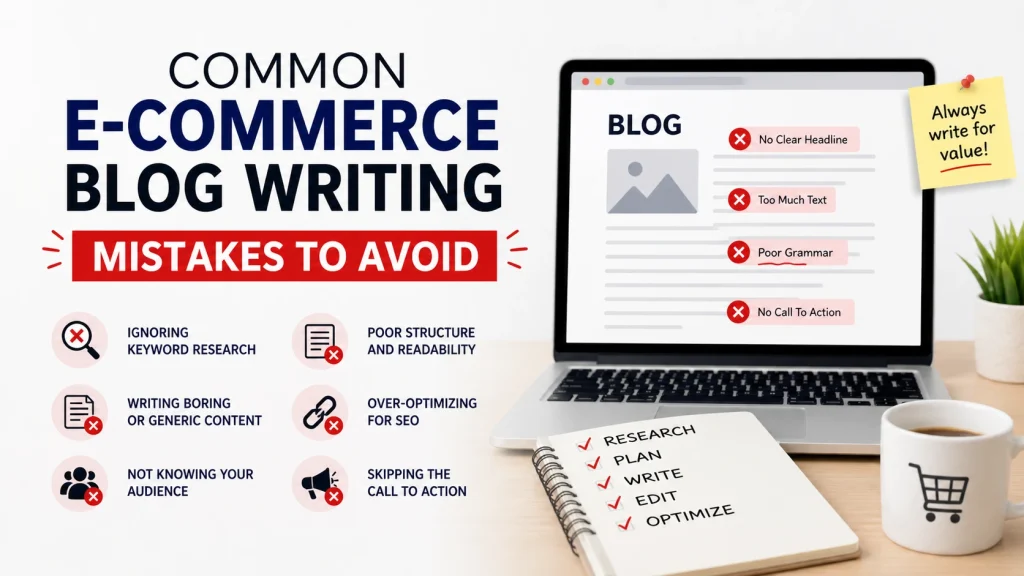
No Clear Call-to-Action (CTA)
A blog without a call-to-action fails to convert traffic into business results.
Every e-commerce blog should guide readers toward the next step.
Effective CTA examples
- Explore product collections
- Read related buying guides
- Contact for expert consultation
- Subscribe for updates
Why CTA is important for conversions
Without a CTA, users leave without taking action. This reduces ROI from content marketing.
Our content strategy ensures every blog includes natural and strategic CTAs.
E-E-A-T and Professional E-Commerce Content Strategy
Google evaluates content based on E-E-A-T: Experience, Expertise, Authoritativeness, and Trustworthiness.
How we apply E-E-A-T
- We use real e-commerce industry knowledge
- We write with SEO and conversion experience
- We maintain factual, helpful, and transparent content
- We build authority through a structured content strategy
This is especially important in the USA market, where competition and content standards are very high.
Final Thoughts
E-commerce blog writing mistakes can significantly reduce your website’s SEO performance and sales potential. However, these issues are completely fixable with the right strategy.
In the USA ecommerce market, success depends on precision, structure, and intent-driven writing.
If your business wants to improve rankings, increase organic traffic, and boost conversions, professional e-commerce blog writing is essential.
At our service, we specialize in creating SEO-optimized, high-converting ecommerce content tailored for USA audiences.
FAQs on Common E-commerce Blog Writing Mistakes to Avoid
1. Why do e-commerce blogs fail to rank in the USA market?
Most blogs fail due to weak SEO, poor keyword strategy, and ignoring search intent.
2. How important is search intent in e-commerce blog writing?
It is critical because Google ranks content based on how well it matches user intent.
3. What is the ideal length for e-commerce blog posts?
High-ranking ecommerce blogs usually range between 1200 to 2000 words.
4. How does professional blog writing improve e-commerce sales?
It improves visibility, builds trust, and guides users toward purchasing decisions.
5. Why should I choose a professional e-commerce blog writing service?
Because expert writers ensure SEO optimization, better rankings, and higher conversions.

