When businesses try to rank on Google, they often target searches like “SEO services near me,” “best digital marketing strategy,” or “how to rank higher on Google.” These searches represent different levels of intent, and ranking for them requires a well-planned content strategy.
One of the biggest questions in SEO today is whether to focus on creating fewer, highly detailed pages or publishing many pages targeting different keywords. Some websites dominate rankings with long-form, in-depth content, while others succeed by covering a wide range of topics.
This brings us to an important strategic decision: content depth vs content breadth. Understanding how these two approaches work and when to use them is critical for building a scalable and effective SEO strategy.
What Is Content Depth in SEO
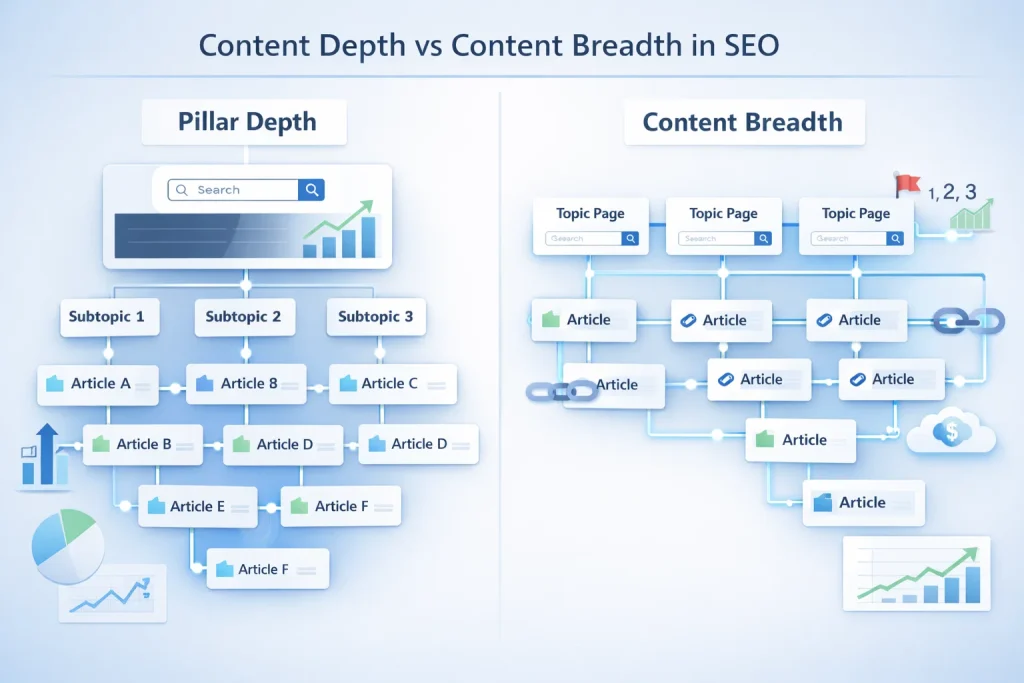
Content depth refers to creating highly detailed, comprehensive content focused on a specific topic. Instead of spreading efforts across multiple pages, this strategy aims to cover a subject as thoroughly as possible within a single page or a tightly connected group of pages.
Characteristics of Deep Content
Deep content is designed to provide complete value to the user. It answers multiple questions, covers subtopics, and delivers detailed insights that reduce the need for users to search elsewhere.
Benefits of Content Depth
One of the main advantages of deep content is its ability to build authority. Search engines recognize comprehensive content as more valuable, which can lead to higher rankings and better engagement metrics.
When to Focus on Depth
Content depth works best when targeting competitive keywords, educational topics, or pillar pages. It is especially useful when you want to establish expertise in a specific area.
What Is Content Breadth in SEO
Content breadth focuses on covering a wide range of topics by creating multiple pages, each targeting different keywords or variations. Instead of going deep into one subject, this strategy expands horizontally across related topics.
Characteristics of Broad Content
Broad content includes multiple pages that each focus on specific keyword variations, services, or use cases. These pages are often shorter but highly targeted.
Benefits of Content Breadth
This approach increases your chances of ranking for multiple keywords. It allows websites to capture diverse search queries and reach a wider audience.
When to Focus on Breadth
Content breadth is ideal for targeting long-tail keywords, local SEO, and scalable strategies like programmatic SEO. It is commonly used by service businesses and SaaS platforms.
Content Depth vs Content Breadth: Key Differences
Choosing between depth and breadth is not just a technical decision. It is a strategic choice that affects how your website grows, how users interact with your content, and how search engines evaluate your authority. Each approach has its strengths and limitations, and understanding these differences helps you make better SEO decisions.
The key is recognizing that depth and breadth serve different purposes. One focuses on authority and engagement, while the other focuses on reach and scalability. A clear comparison highlights where each strategy fits best.
- Depth focuses on one topic deeply
- Breadth covers multiple topics
- Depth builds authority on a single topic
- Breadth increases keyword coverage
- Depth improves engagement
- Breadth increases traffic opportunities
Why This Debate Matters for SEO
Search engines are constantly evolving to deliver the most relevant and valuable results to users. They evaluate content based on quality, relevance, and how well it satisfies user intent. This makes the choice between depth and breadth more important than ever.
A poorly planned strategy can result in missed ranking opportunities or weak content performance. Understanding how each approach impacts SEO helps businesses align their content with search engine expectations.
- Impacts topical authority
- Affects keyword rankings
- Influences internal linking
- Determines content scalability
- Impacts crawlability
Role of Topical Authority in Depth vs Breadth
Topical authority is the bridge between content depth and content breadth. It represents how well your website covers a subject and how credible it appears to search engines.
Topic Clusters and Pillar Pages
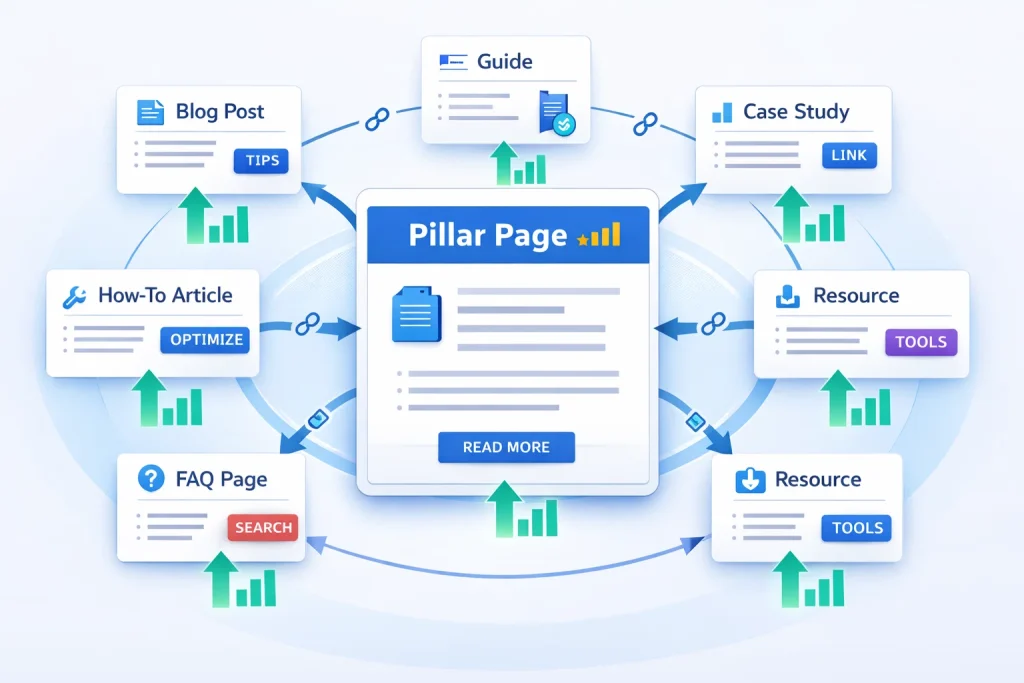
Topic clusters are a strategic way to combine depth and breadth. A pillar page covers a broad topic in depth, while supporting pages target related subtopics. This creates a strong internal linking structure.
Semantic SEO and Content Relationships
Search engines analyze relationships between topics, not just individual keywords. By connecting related content, you signal relevance and expertise, improving your chances of ranking.
How to Balance Content Depth and Breadth

In most cases, the best SEO strategy is not choosing one over the other but combining both effectively. A balanced approach allows you to build authority while also capturing a wide range of search queries.
This requires careful planning, where each piece of content serves a specific role within your overall SEO strategy. Instead of random publishing, your content should follow a structured system.
- Start with pillar content
- Expand with supporting articles
- Use internal linking
- Cover keyword variations
- Update and expand existing content
Common SEO Mistakes in Content Strategy
Many websites fail to see results because they misunderstand how to apply depth and breadth. Focusing too much on one approach without proper execution can weaken your SEO performance.
Poor planning often leads to content that either lacks value or fails to scale effectively. Avoiding these mistakes is essential for long-term success.
- Creating thin broad content
- Overloading one page with too much content
- Ignoring internal linking
- Not targeting search intent
- Lack of content structure
Does Blog Content Help Balance Depth and Breadth
Blog content plays a crucial role in bridging the gap between depth and breadth. It allows businesses to expand their content strategy while maintaining structure and relevance.
A well-planned blog acts as a support system for your main pages, helping improve visibility, authority, and internal linking across your website.
- Supports pillar pages
- Expands keyword coverage
- Improves internal linking
- Builds topical authority
- Drives organic traffic
Real-World Examples of Depth vs Breadth Strategy
Understanding how these strategies work in real-world scenarios makes it easier to apply them effectively.
Service Business Strategy
Service businesses often use breadth by creating multiple location and service pages while using depth for core service pages.
SaaS Website Strategy
SaaS companies typically combine both approaches by creating in-depth guides and scaling comparison or feature pages.
Niche Blog Strategy
Niche blogs often start with depth to build authority and then expand into breadth to capture more traffic.
Final Thoughts
Content depth and content breadth are not competing strategies but complementary ones. While depth builds authority and trust, breadth expands reach and visibility.
The most effective SEO strategies combine both approaches, creating a structured content ecosystem that supports long-term growth. By balancing depth and breadth, businesses can maximize their rankings, traffic, and overall SEO performance.
FAQs about Content Depth vs Content Breadth in SEO
What is content depth in SEO?
Content depth refers to creating comprehensive, detailed content that fully covers a specific topic.
What is content breadth in SEO?
Content breadth involves creating multiple pages targeting different keywords and topics to expand reach.
Which is better: content depth or breadth?
Neither is better alone. A balanced approach combining both works best for most SEO strategies.
How does topical authority affect SEO?
Topical authority improves rankings by signaling expertise and relevance to search engines.
Should I create more pages or longer content?
You should do both strategically, depending on your goals and keyword opportunities.
How do you balance depth and breadth?
By using pillar pages, supporting content, and strong internal linking structures.
Does long-form content rank better than short content?
Long-form content often performs better when it provides more value, but quality matters more than length.