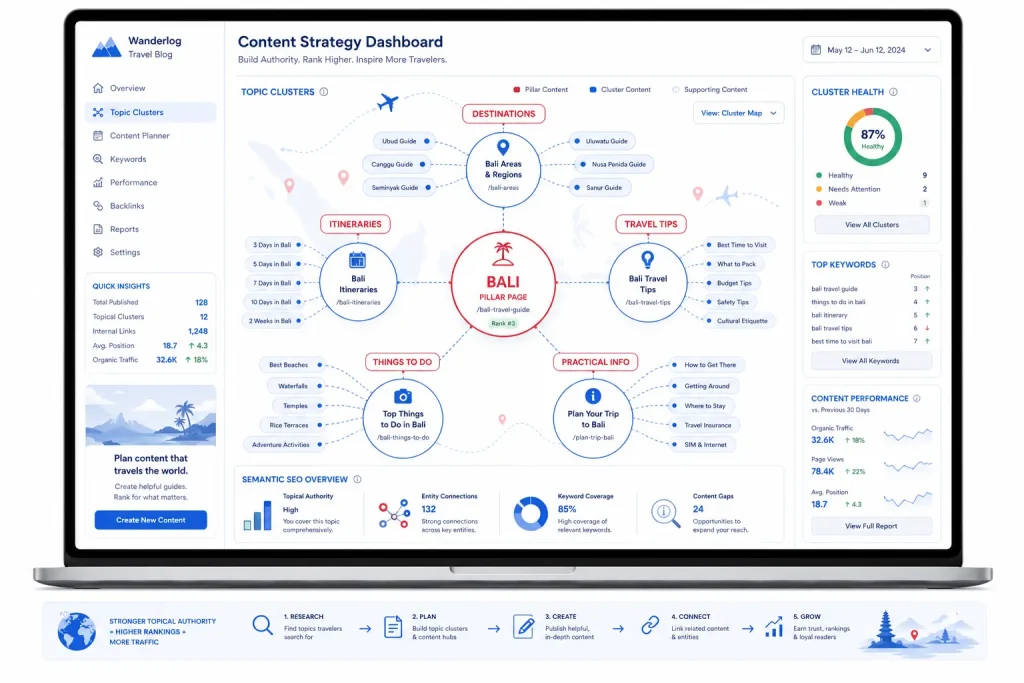
Complete Guide to Higher Rankings
Travel blogging has evolved far beyond simply inserting keywords into articles. Today, search engines evaluate how well your content understands a topic, not just how often a keyword appears. This shift has made many traditional SEO tactics ineffective in the travel niche.
When users search for queries like “things to do in Rome,” “best beaches in Thailand,” or “budget travel tips,” they expect detailed, structured, and context-rich information. If your content only targets a single keyword without covering the broader topic, it struggles to compete.
Semantic SEO for travel content focuses on meaning, relationships, and intent. It helps you create content that aligns with how search engines interpret topics, ultimately improving rankings, relevance, and user engagement.
What Is Semantic SEO for Travel Content
Semantic SEO is the process of optimizing content based on context, intent, and relationships between words and topics rather than relying solely on exact-match keywords.
How Search Engines Understand Travel Content
Search engines analyze entities, context, and user behavior to determine what a piece of content is about. For travel content, this means understanding destinations, activities, seasons, and traveler intent.
Semantic SEO vs Traditional Keyword SEO
Traditional SEO focuses on repeating keywords. Semantic SEO focuses on covering topics comprehensively using related terms, natural language, and structured content.
Why Semantic SEO Matters in the Travel Niche
The travel niche is highly competitive, with thousands of websites targeting similar keywords. Search engines prioritize content that provides complete and meaningful information rather than fragmented or repetitive content.
Semantic SEO helps your content stand out by improving relevance and aligning with user expectations. It ensures that your content answers multiple related queries within a single topic.
- Improves rankings
- Enhances relevance
- Matches user intent
- Increases traffic
- Builds authority
Understanding Search Intent in Travel SEO
Search intent is a critical component of semantic SEO. Without understanding what users want, even well-written content can fail to perform.
Informational Travel Queries
Users are looking for general information, such as “things to do in Paris” or “best time to visit Bali.”
Planning-Based Queries
These users are planning their trips and need detailed guidance like itineraries, budgets, and recommendations.
Booking/Transactional Queries
Users are ready to take action, such as booking hotels, tours, or flights.
Using Keyword Variations and Entities in Travel Content
Instead of repeating the same keyword, semantic SEO encourages the use of variations and related entities. This approach makes content more natural and comprehensive.
By including different ways of expressing the same idea, you improve both readability and SEO performance.
- Use synonyms
- Include related terms
- Mention locations and entities
- Avoid keyword stuffing
- Improve natural flow
Building Topic Clusters for Travel SEO
Topic clusters are essential for semantic SEO because they help organize content into structured groups. This improves both user experience and search engine understanding.
A well-built cluster allows you to cover a topic fully while connecting related content.
- Destination clusters
- Travel guides
- Supporting blogs
- Content relationships
- Internal structure
Improving Content Depth and Coverage
Content depth is one of the most important ranking factors in semantic SEO. Travel content should go beyond surface-level information and provide real value.
Instead of writing short posts, focus on creating detailed guides that answer all possible questions related to a topic. At the same time, expand into related subtopics to improve coverage.
Internal Linking for Semantic SEO
Internal linking strengthens the relationships between your content. It helps search engines understand how different pages are connected and improves overall site structure.
A strong internal linking strategy enhances both SEO performance and user navigation.
- Connect related topics
- Use contextual anchors
- Improve navigation
- Distribute authority
- Strengthen structure
Content Structure and Readability Optimization
Well-structured content is easier for both users and search engines to understand. Travel blogs should focus on clarity, organization, and readability.
Proper formatting ensures that users can quickly find the information they need.
- Use headings properly
- Break content into sections
- Add bullet points
- Improve readability
- Optimize formatting
Common Semantic SEO Mistakes in Travel Blogs
Many travel bloggers struggle with semantic SEO because they rely on outdated practices. These mistakes limit content performance and reduce visibility.
Avoiding these issues is essential for long-term success.
- Keyword stuffing
- Thin content
- Ignoring search intent
- Poor structure
- Weak internal linking
Step-by-Step Semantic SEO Strategy for Travel Content
Implementing semantic SEO requires a structured approach. Without a clear process, it becomes difficult to maintain consistency and quality.
A step-by-step strategy ensures that your content is optimized effectively.
- Research topics
- Understand search intent
- Create structured content
- Add internal links
- Optimize continuously
Final Thoughts
Semantic SEO for travel content is about creating meaningful, well-structured, and comprehensive content that aligns with user intent. It moves beyond simple keyword usage and focuses on delivering real value.
By combining topic clusters, keyword variations, internal linking, and content depth, you can significantly improve your rankings and visibility. Over time, this approach helps your travel blog become a trusted resource for users and a strong competitor in search results.
FAQs on Semantic SEO for Travel Blogs
1. What is semantic SEO in travel content?
It is the process of optimizing travel content based on context, intent, and topic relationships.
2. How does semantic SEO work?
It works by using related terms, covering topics deeply, and aligning content with user intent.
3. What are semantic keywords?
They are related words and phrases that help search engines understand the context of your content.
4. How to optimize travel blogs for semantic SEO?
By using keyword variations, building topic clusters, and improving content structure.
5. Does semantic SEO improve rankings?
Yes, it improves relevance, which helps boost rankings.
6. What is the difference between keywords and entities?
Keywords are search terms, while entities represent concepts or topics understood by search engines.
7. How long does semantic SEO take to work?
It usually takes a few months depending on consistency and competition.