
In the modern SaaS landscape, “writing” is not enough; your technical content must act as an authoritative bridge between your product’s complex architecture and your customer’s most pressing pain points. At blogwriting.services, we provide SEO-optimized technical writing tailored specifically for B2B SaaS, ensuring your brand ranks for high-intent queries that move the needle.
We translate dense API documentation, intricate feature sets, and complex workflows into crystal-clear narratives that earn the trust of technical decision-makers and developers alike.

By combining rigorous SEO strategies—such as topical authority mapping and AI-ready schema implementation—with deep technical literacy, we ensure your content dominates search results and satisfies the strict requirements of AI-driven engines.
We don’t just target keywords; we target the intent behind them, positioning your product as the obvious solution for users who are already problem-aware and ready to convert. Whether you need deep-dive tutorials, comparison battlegrounds, or comprehensive developer guides, our service is built to lower your customer acquisition costs and establish your platform as the definitive authority in your niche.
The Growth Engine Your Product Needs
In today’s competitive SaaS market, building a great product is not enough. If your ideal customers cannot find you, your growth will stall. Most SaaS blogs fail because they focus on publishing rather than performance. To win in 2026, your content must do more than exist—it must rank, attract the right users, and convert them into customers. That is where SEO-optimized technical writing becomes your biggest advantage.
By treating your blog as a precision-engineered growth engine rather than a content repository, you stop chasing vanity metrics and start building a predictable pipeline. Our approach focuses on the intersection of deep technical literacy and search intent, ensuring your software’s complex value proposition translates into actionable insights for the very people who need them most.
When you replace generic filler with content that speaks the language of developers, product leads, and decision-makers, you don’t just gain visibility—you gain trust. In an era where AI-driven search models dominate discovery, this depth is the only way to ensure your brand remains the go-to authority for your industry. Start solving the problems that keep your users up at night, and watch as your content transforms from a cost center into your most effective customer acquisition channel.
Why Most SaaS Content Fails
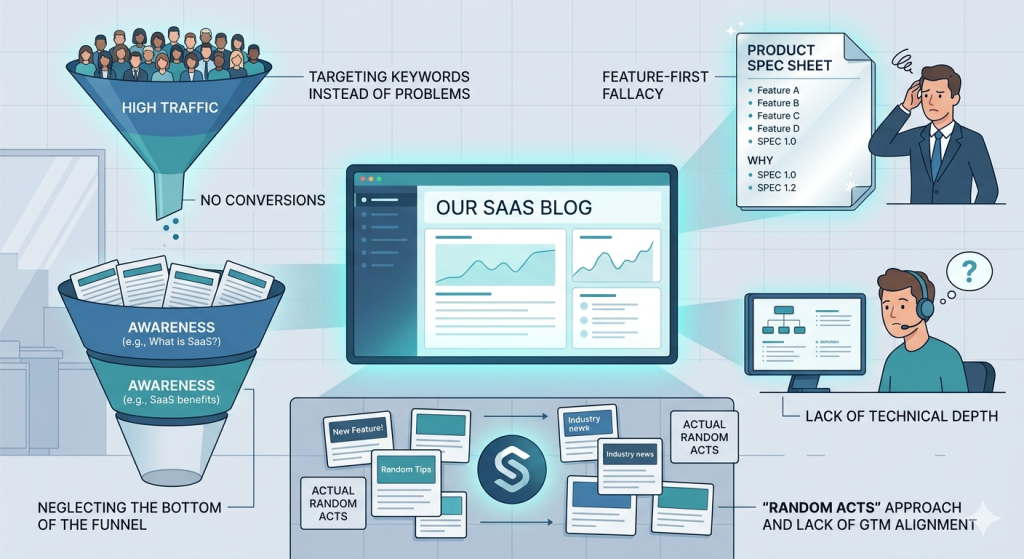
Most SaaS companies invest heavily in content, yet a staggering majority—roughly 71%—admit their strategy is ineffective. The failure usually stems from treating content as a random act of publishing rather than a strategic business asset.
The Content Trap: Why SaaS ROI Stalls
The primary reason for this failure is a fundamental misalignment between the content created and the business’s actual revenue goals. Here is why most strategies break down:
- Targeting Keywords Instead of Problems: Companies often prioritize search volume over actual buyer intent. They write articles that attract general curious browsers who have no intention—or capacity—to purchase, leading to high traffic but zero conversions.
- The “Feature-First” Fallacy: Content that focuses purely on product specs and technical features often alienates the reader. Buyers don’t care about the “what”; they care about the “why”—how your tool eliminates a specific workflow bottleneck or drives growth.
- Neglecting the Bottom of the Funnel: Many SaaS firms saturate their blog with “awareness” content, ignoring the critical decision-stage buyers who need comparison guides, use cases, and integration playbooks to finalize their purchase.
- Lack of Technical Depth: B2B buyers, particularly technical decision-makers, are discerning. When companies oversimplify or “dumb down” content to cast a wider net, they lose the very experts and engineers whose buy-in they need to close the deal.
- The “Random Acts” Approach: Without a defined roadmap or alignment with the company’s Go-to-Market (GTM) strategy, content becomes inconsistent and disconnected. When content is created in isolation from the product’s evolution, it quickly becomes irrelevant.
Ultimately, the failure is rarely a lack of writing—it is a lack of strategy. When content is not mapped to specific stages of the funnel, lacks clear revenue attribution, and fails to solve real-world user pains, it becomes a cost center instead of a growth engine
What Is SEO-Optimized Technical Writing for SaaS?
SEO-optimized technical writing for SaaS is a strategic framework that bridges the gap between complex software capabilities and the specific information needs of your target audience. Unlike generic blog writing, which often focuses on high-volume, low-intent keywords, this approach ensures that your content is purpose-built to satisfy both human users and the sophisticated AI algorithms that now dominate the search landscape
SEO-optimized technical writing for SaaS is a strategic framework that bridges the gap between complex software capabilities and the specific information needs of your target audience. Unlike generic blog writing, which often focuses on high-volume, low-intent keywords, this approach ensures that your content is purpose-built to satisfy both human users and the sophisticated AI algorithms that now dominate the search landscape.
At its core, this discipline integrates three essential pillars:
- Technical Accuracy: Built on deep subject matter expertise, this pillar ensures your content provides precise, jargon-appropriate explanations for APIs, complex workflows, and system architectures. It builds immediate trust with technical decision-makers and developers who rely on your documentation or guides to solve real-world problems.
- Search-Engine Optimization: This involves structuring content so that search crawlers and generative AI models can easily interpret, index, and cite it. This includes utilizing clean hierarchical heading structures (H1–H3), implementing structured data (schema markup) for rich snippets, and ensuring content is formatted for AI Overview inclusion via lists, tables, and concise definitions.
- Conversion-Focused Strategy: Every piece of content is engineered to guide the reader through the buyer’s journey. By aligning your topics with the specific “problem-aware” queries your customers are searching for, you can weave your product features into the narrative, providing seamless, frictionless calls to action that move readers from information-gathering to product trials or demo requests.
Why SaaS Businesses Need Technical Content
Attract High-Intent Traffic
Attracting high-intent traffic is the cornerstone of sustainable SaaS growth. High-intent traffic features users who are already problem-aware and searching for a solution, unlike broad traffic that only increases your visitor count. These individuals are further down the sales funnel, making them significantly more likely to convert into trials, demos, or paid users.
Build Authority in Competitive Markets
In a saturated SaaS market, generic “thought leadership” is no longer enough to move the needle. When your product competes in a crowded space, your content strategy must shift from being a megaphone to being an authority—a source of truth that users and search engines rely on to solve complex problems.
Support Product-Led Growth (PLG)
In a Product-Led Growth model, your blog acts as the front door to your product experience rather than just a source of information. When you align your content strategy with product adoption, you shorten the time-to-value for your users and turn passive readers into active, engaged accounts.
Reduce Customer Acquisition Cost (CAC)
In the high-stakes environment of SaaS growth, relying solely on paid acquisition is a precarious strategy; the moment you tap the brakes on your ad spend, your pipeline dries up instantly. Paid ads stop working the moment you stop paying. In contrast, SEO-optimized technical content is a compounding asset that attracts high-intent users for months or even years.
Intent-Driven Keyword Research
In an era where “search volume” is a vanity metric, the most successful SaaS brands have pivoted to Intent-Driven Keyword Research.
Targeting a keyword simply because it has thousands of monthly searches is a recipe for wasted budget; instead, we prioritize queries that signal a clear desire to solve a problem, evaluate a solution, or make a purchase.
Topic Clusters (Topical Authority Model)
Topical Authority is the modern gold standard for SaaS SEO, and building it requires moving away from the “scattershot” publishing approach.
At blogwriting.services, we utilize the Topic Cluster Model—a structured framework that signals to search engines and AI models that your brand is the definitive source of truth in your specific niche.
Product-Led Content Strategy
A Product-Led Growth (PLG) content strategy moves beyond the traditional “informational” blog. Instead of treating your content as a separate entity, we treat it as an extension of your user interface, directly guiding readers from a pain point to a platform solution.
At blogwriting.services, we ensure every article serves as a functional step in your funnel, transforming passive readers into active trial users.
Technical Depth + Simplicity
Striking the perfect balance between technical rigor and readability is the greatest challenge in SaaS content. If you lean too far toward technical jargon, you alienate decision-makers; lean too far toward simplicity, and you lose the trust of the engineers and architects who act as your product’s “gatekeepers.” At blogwriting.services, we master this balance by applying a “layer-cake” writing architecture to every project.
The Art of the Layered Explanation
We design our content to satisfy two distinct audiences simultaneously: the high-level leader and the “in-the-trenches” practitioner. This ensures your brand is viewed as both accessible to the business and authoritative to the technical lead.
- Valuable for Experts (The Technical Core): We don’t shy away from the underlying complexity. We include code snippets, data flow diagrams, API endpoints, and configuration examples that allow experts to “verify” your expertise instantly. By providing this depth, we confirm that your solution is robust enough to handle their specific infrastructure requirements.
- Easy for Beginners/Decision-Makers (The Narrative Wrapper): We wrap those complex details in clear, benefits-first language. We frame every technical section with a “why this matters” statement. We explain the business impact of each feature and show how reduced latency increases conversion rates. Then, we show how better data syncing improves team efficiency.
- Scannable Structure for All: Busy professionals don’t read every word; they scan. We use clear subheadings (H2 and H3). We add bullet points for technical details and highlight key takeaways in bold. This helps a CTO understand value quickly. It also gives engineers the depth they need.
Why This Balance Builds Trust
When your content is clear but technically sound, you avoid the “fluff trap” that plagues generic agencies.
- Credibility by Design: Experts appreciate it when you respect their time by providing direct, accurate answers rather than “dumbing down” the solution to a generic level.
- Internal Advocacy: Often, your buyer is an executive who needs to “sell” your product to their technical team. Our layered approach gives them the high-level business case and the technical proof they need to secure internal sign-off.
- Search-Engine Alignment: Modern search algorithms and AI models are becoming increasingly sophisticated at identifying “shallow” content. Detailed technical content proves your expertise to search engines. This builds the trust required to satisfy Google’s E-E-A-T criteria. As a result, you rank higher for your industry’s most valuable searches.
At blogwriting.services, we ensure your content serves as a translator, not just a writer. We translate the “black box” of your software into clear, actionable value that every stakeholder in your customer’s company can understand, respect, and ultimately, buy.
SEO + AI Optimization
In the 2026 search landscape, traditional SEO is no longer enough. Search has moved beyond ten blue links to a reality defined by Generative Search Experiences (GSEs) and AI-driven aggregators. At blogwriting.services, we engineer your content to thrive in this new environment by optimizing specifically for how AI models process, synthesize, and cite information.
Engineering Content for the AI Era
AI models like ChatGPT, Gemini, and Perplexity are used to answer user queries. We achieve this by optimizing your content for three specific AI-readiness pillars:
- Optimizing for AI Overviews: AI models prioritize content that is direct, structured, and easy to parse. We replace rambling paragraphs with concise, factual definitions, step-by-step numbered lists, and comparison tables. We provide clear, concise answers to make your content easy for AI to feature. This helps you capture the top spot in search results.
- Dominating Featured Snippets: We use semantic SEO to directly answer the most important questions about your topic. Through optimized FAQs, we capture the “Position Zero” search result. This establishes your brand as the most reliable solution for user pain points.
- Structured Data and Schema Markup: To ensure AI crawlers understand your content’s hierarchy and context, we deploy advanced Schema Markup (such as Article, FAQPage, and Product schemas). This gives machines a clear map of your content. They understand what your product is and see how it works. They identify the problems it solves and increase your chances of being cited as a primary source.
Why This Future-Proofs Your Growth
The benefit of 2026-ready optimization is twofold:
- Brand visibility in a “zero-click” world is evolving fast. As search engines deliver answers directly, users often get what they need without visiting a site. To stay visible, you must get cited in AI Overviews—this is the new source of traffic. When an AI cites your site as its source, it drives high-intent visitors who already view your brand as the industry authority.
- Increased Trustworthiness: AI models prioritize sources with high E-E-A-T (Experience, Expertise, Authoritativeness, and Trustworthiness). By structuring your content clearly and including verifiable technical depth, we help your site earn the “trusted source” designation, ensuring your visibility remains stable even as search algorithms shift.
At blogwriting.services, we treat search as a technical system, not just a marketing channel. We structure your content for human readers. We also optimize it for machine intelligence.
This helps search systems understand your content. It also improves your chances of being selected and shown. This is how we keep your SaaS product front-and-center in the most competitive search environment in history.

