Complete SEO Guide
Educational websites often invest heavily in creating high-quality content, detailed courses, and informative blogs. Yet many of them struggle to achieve strong rankings on Google. The problem is not always the content itself, but how that content is connected across the website.
Search engines rely on internal links to discover pages, understand relationships between topics, and determine which pages are most important. At the same time, users depend on these links to navigate through learning paths, explore related topics, and move from blogs to course pages.
An effective internal linking strategy for educational websites ensures that your content works as a connected system rather than isolated pages. It improves crawlability, distributes authority, and guides users toward meaningful actions like course enrollment.
What Is Internal Linking in SEO
Internal linking in SEO refers to linking one page of your website to another page within the same domain. These links help search engines understand your website structure and the relationship between different pieces of content.
Types of Internal Links
Internal links can appear in different forms depending on their purpose, including navigation menus, contextual links within content, and structural links like breadcrumbs.
How Internal Links Work
When a search engine crawls your website, it follows internal links to discover new pages and evaluate how content is connected. These links also pass value between pages, helping search engines determine which pages are more important.
Why Internal Linking Is Important for Educational Websites
Educational websites often contain large volumes of interconnected content, including blogs, course pages, guides, and resources. Without proper internal linking, this content becomes fragmented, making it difficult for search engines to understand its structure.
A well-planned internal linking SEO strategy ensures that all pages are accessible, connected, and optimized for both users and search engines. It also improves how authority flows across your website.
- Improves crawlability
- Distributes link equity
- Enhances user navigation
- Supports rankings
- Builds topic relevance
Types of Internal Links You Should Use
Not all internal links serve the same purpose. Using a mix of different link types helps create a balanced and effective linking structure that supports both SEO and usability.
Each type plays a specific role in guiding users and helping search engines understand your website structure.
- Navigational links
- Contextual links
- Footer links
- Sidebar links
- Breadcrumb links
Anchor Text Optimization for Internal Links
Anchor text is the clickable text used in a link. It provides context to both users and search engines about the content of the linked page.
Optimizing anchor text is essential for improving relevance and SEO performance. Instead of using generic phrases like “click here,” descriptive and keyword-rich anchors help search engines understand the topic of the linked page.
For educational websites, anchor text should align with the topic of the destination page, whether it is a blog post, course page, or resource.
Using Topic Clusters for Internal Linking
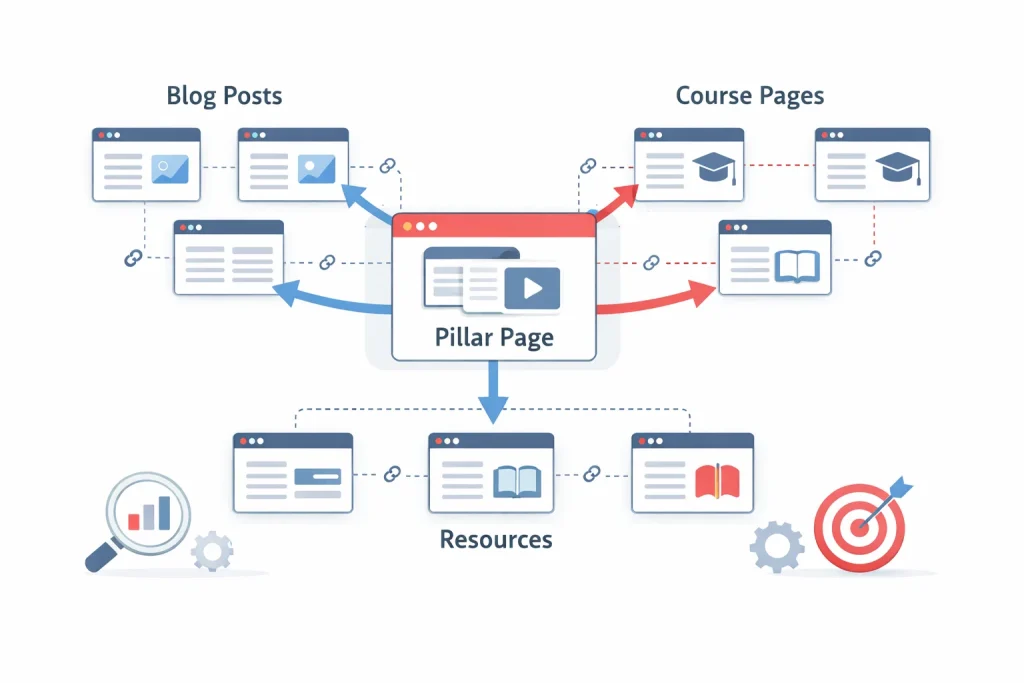
Topic clusters are a powerful way to structure internal links. They organize content around a central topic, connecting related pages in a logical and meaningful way.
This approach helps search engines understand the depth of your content while improving user navigation across related topics.
- Create pillar pages
- Link supporting content
- Maintain relevance
- Use consistent anchors
- Strengthen authority
Internal Linking for Course Pages and Blogs
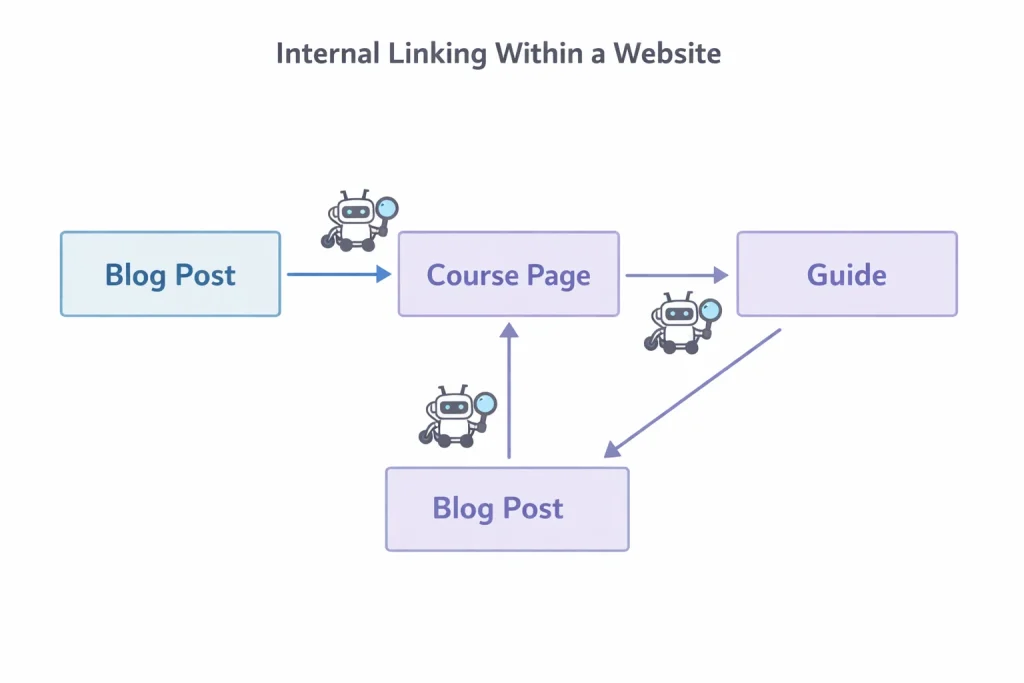
Educational websites often have two main types of content: blogs and course pages. A strong internal linking strategy connects these two effectively.
Blogs can target informational keywords and attract traffic, while course pages focus on conversions. Linking from blogs to relevant courses helps guide users through their learning journey and increases the chances of enrollment.
Similarly, course pages can link back to supporting blog content to provide additional value and improve engagement.
How Internal Links Pass SEO Value
Internal links do more than just connect pages—they also pass SEO value, often referred to as link equity. This value helps search engines determine which pages are more authoritative and relevant.
Pages that receive more internal links, especially from high-value pages, are considered more important. This is why linking strategically is critical for improving rankings.
Educational websites should prioritize linking to key pages such as high-converting course pages or important topic hubs. By doing this, you ensure that your most valuable pages receive the authority they need to rank.
Link Distribution and Crawlability
Proper link distribution ensures that all important pages receive enough internal links while maintaining a balanced structure. Poor distribution can result in some pages being overlinked while others remain hidden.
A well-structured internal linking system improves crawlability and ensures that search engines can easily access all pages.
- Link important pages more
- Avoid orphan pages
- Maintain balance
- Optimize depth
- Improve crawl paths
Internal Linking Audit and Tools
Regular audits are essential to maintain a strong internal linking strategy. Over time, websites grow, and links can become outdated, broken, or ineffective.
Conducting an audit helps you identify gaps, fix issues, and improve overall performance. Tools can simplify this process and provide valuable insights into your internal linking structure.
Using tools allows you to:
- Identify broken links
- Find orphan pages
- Analyze link distribution
- Improve crawlability
- Track internal link performance
Common Internal Linking Mistakes
Even well-designed educational websites can make mistakes when it comes to internal linking. These issues can limit the effectiveness of your SEO strategy and reduce user engagement.
Avoiding these mistakes ensures that your internal linking strategy remains strong and effective.
- Overlinking
- Irrelevant links
- Generic anchors
- Broken links
- No strategy
Step-by-Step Internal Linking Strategy
Building an effective internal linking strategy requires a structured approach. Without a clear plan, it becomes difficult to manage links as your website grows.
Following a step-by-step process helps ensure that your internal links support both SEO and user experience.
- Audit content
- Identify key pages
- Add contextual links
- Optimize anchors
- Monitor performance
Final Thoughts
Internal linking is one of the most powerful yet overlooked aspects of SEO for educational websites. It connects your content, improves crawlability, and helps search engines understand your site structure.
By focusing on link distribution, anchor text optimization, and topic clusters, you can build a strong internal linking system that supports both rankings and user experience. Over time, this leads to better visibility, higher engagement, and increased course enrollments.
FAQs on Internal Linking Strategy
1. What is internal linking in SEO?
Internal linking is the process of linking one page of a website to another page within the same domain.
2. Why are internal links important?
They help search engines understand your site structure and improve user navigation.
3. How many internal links should a page have?
There is no fixed number, but links should be relevant and not excessive.
4. What is anchor text in internal linking?
It is the clickable text that describes the linked page.
5. Do internal links improve rankings?
Yes, they help distribute authority and improve visibility.
6. How to fix broken internal links?
By auditing your website and updating or removing broken links.
7. What is a topic cluster in SEO?
It is a group of related content linked around a central topic.