Improve Rankings & UX
When users search for terms like “SEO services near me,” “web design services,” or “digital marketing agency,” they expect to land on a website that is simple, clear, and easy to navigate. If users cannot quickly find the information they need, they leave the website within seconds.
Search engines monitor these behaviors closely. A confusing navigation structure leads to higher bounce rates and lower engagement, which negatively impacts rankings. On the other hand, a well-organized navigation system improves both user experience and search engine visibility.
What Is an SEO-Friendly Navigation Structure?
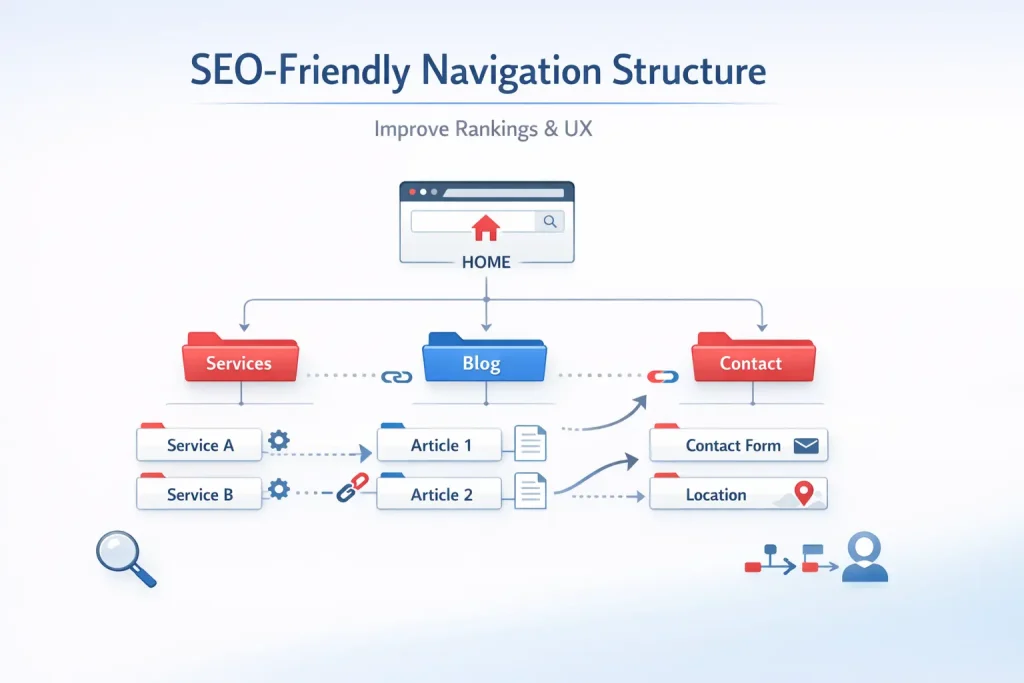
An SEO-friendly navigation structure refers to how pages are organized, linked, and presented across a website. It ensures that both users and search engines can easily access important content without confusion.
A strong navigation system simplifies the user journey while helping search engines understand the relationship between different pages. This improves indexing, ranking, and overall website performance.
Why Navigation Structure Is Important for SEO
Navigation is one of the most critical components of on-page SEO. It directly affects how search engines crawl your website and how users interact with your content.
A well-structured navigation system improves visibility, distributes authority across pages, and enhances engagement metrics. These factors collectively influence how your website ranks in search results.
The main reasons navigation structure is important include
- It helps search engines crawl and index pages efficiently
- It improves user experience and reduces bounce rates
- It distributes link equity across important pages
- It supports better content discovery
- It increases conversion opportunities
Key Elements of an SEO-Friendly Navigation Structure
Before optimizing your navigation, it is important to understand the core elements that define a strong structure. These elements ensure your website is both user-friendly and search engine optimized.
Each component plays a role in improving usability and helping search engines interpret your site.
The key elements include
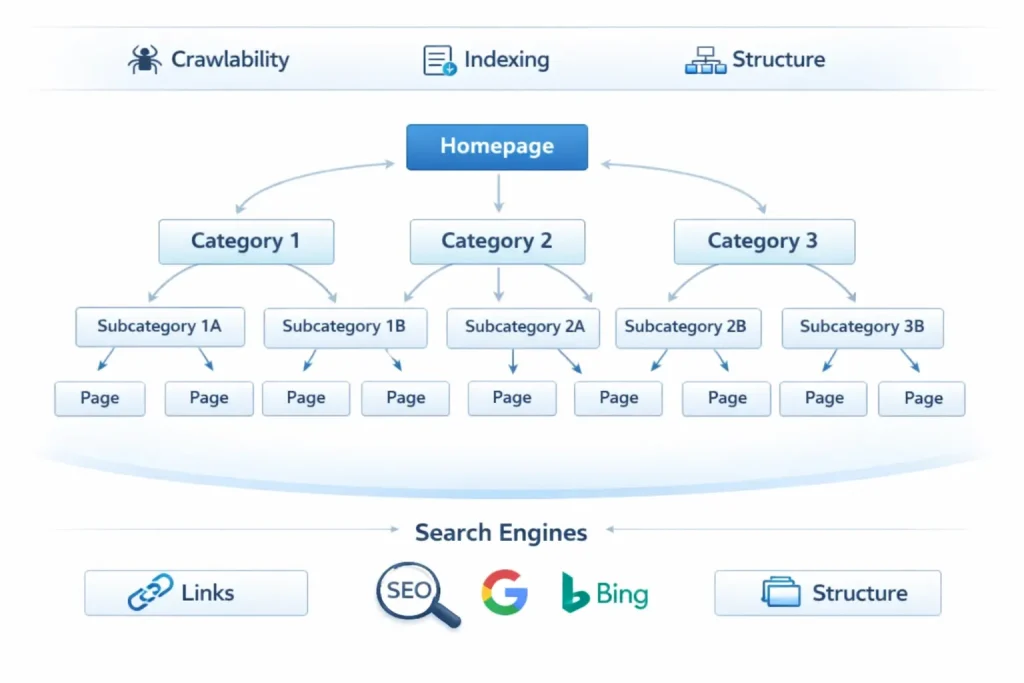
- Clear website hierarchy that organizes pages logically
- Logical URL structure that reflects page relationships
- Internal linking system that connects related content
- Breadcrumb navigation that improves user orientation
- Mobile-friendly navigation for better accessibility
How Website Structure Affects SEO Performance
Your website structure determines how search engines understand your content and how authority flows across pages. A poorly structured website can limit visibility, while a well-optimized structure can significantly improve rankings.
Search engines rely on structure to discover pages, evaluate importance, and determine relevance. A clear structure ensures that all important pages receive proper attention.
The main SEO impacts of website structure include
- Improved crawlability and faster indexing
- Better distribution of link equity across pages
- Stronger user engagement signals such as time on site
Best Practices for SEO-Friendly Navigation
Creating an effective navigation structure requires a balance between simplicity and strategy. Overcomplicated menus confuse users, while overly simple structures may limit content discovery.
A well-planned navigation system ensures users can easily move through your website while search engines can understand its structure.
The best practices include
- Keeping navigation simple and intuitive
- Using descriptive anchor text for links
- Limiting click depth so pages are easy to reach
- Prioritizing important pages in the main menu
- Optimizing navigation for mobile users
Navigation Structure for Service-Based Websites
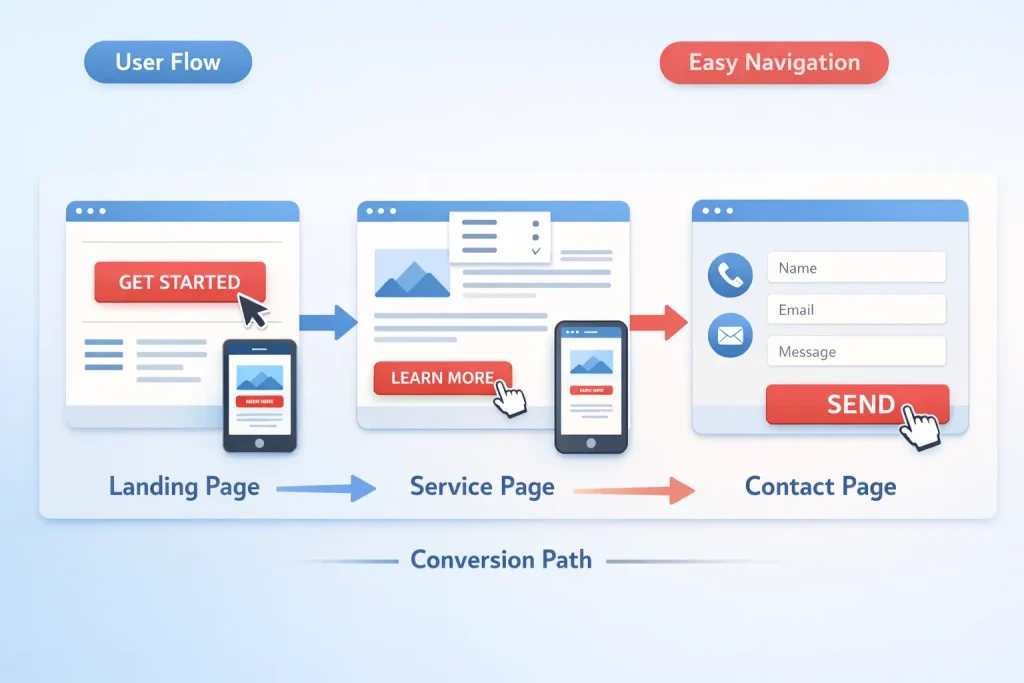
Service-based websites require a navigation structure that not only improves SEO but also drives conversions. Users visiting these websites are often looking for specific services, locations, or contact information.
A well-structured navigation ensures that users can quickly find what they need and take action.
The key navigation strategies include
- Creating dedicated service pages for each offering
- Organizing location-based pages for local SEO
- Designing navigation paths that lead users toward conversion points
Navigation and Internal Linking Strategy
Navigation and internal linking work together to create a strong SEO foundation. While navigation provides the main structure, internal links connect deeper content and guide users through the website.
A well-planned internal linking strategy improves both usability and search engine understanding.
Important internal linking practices include
- Using contextual links within content
- Building hub and cluster structures for topics
- Linking to priority pages to improve their authority
SEO-Friendly Navigation for AEO (Future SEO)
As search engines evolve toward AI-driven systems, navigation must support structured content understanding. AI systems rely on clear relationships between topics to generate accurate answers.
An organized navigation structure helps both users and machines interpret your website more effectively.
The key AEO-focused strategies include
- Creating a semantic structure that reflects topic relationships
- Using entity-based navigation to connect related concepts
- Maintaining a structured content flow across pages
Common Navigation Structure Mistakes
Many websites fail to achieve strong SEO performance due to poor navigation design. These issues often create confusion for users and limit search engine visibility.
Avoiding these mistakes is essential for building a high-performing website.
Common mistakes include
- Overcomplicated menus that overwhelm users
- Broken internal links that disrupt navigation
- Deep page structures that make content hard to reach
- Poor mobile navigation that reduces usability
Final Thoughts
An SEO-friendly navigation structure is essential for building a website that performs well in search results. It improves crawlability, enhances user experience, and supports better content discovery.
By focusing on simplicity, structure, and strategic linking, businesses can create a navigation system that drives both rankings and conversions.
FAQs about SEO friendly navigational structure
What is an SEO-friendly navigation structure?
It is a system that organizes and links pages to improve usability and search engine understanding
How does navigation affect SEO?
It impacts crawlability, indexing, and user engagement, which influence rankings
What is the best website structure for SEO?
A clear hierarchical structure with logical linking and shallow depth works best
How many clicks should a page be from the homepage?
Ideally, important pages should be within three clicks from the homepage
Does navigation impact user experience?
Yes, it directly affects how easily users can find information
What is breadcrumb navigation?
It is a secondary navigation system that shows users their location on a website
How do I improve my website navigation?
By simplifying menus, improving internal links, and optimizing for mobile usability