When users search for queries like “SEO services near me,” “digital marketing agency,” or “best SEO strategy,” search engines rely heavily on how well your website is structured. Internal linking plays a crucial role in helping search engines understand your content, prioritize pages, and deliver the most relevant results.
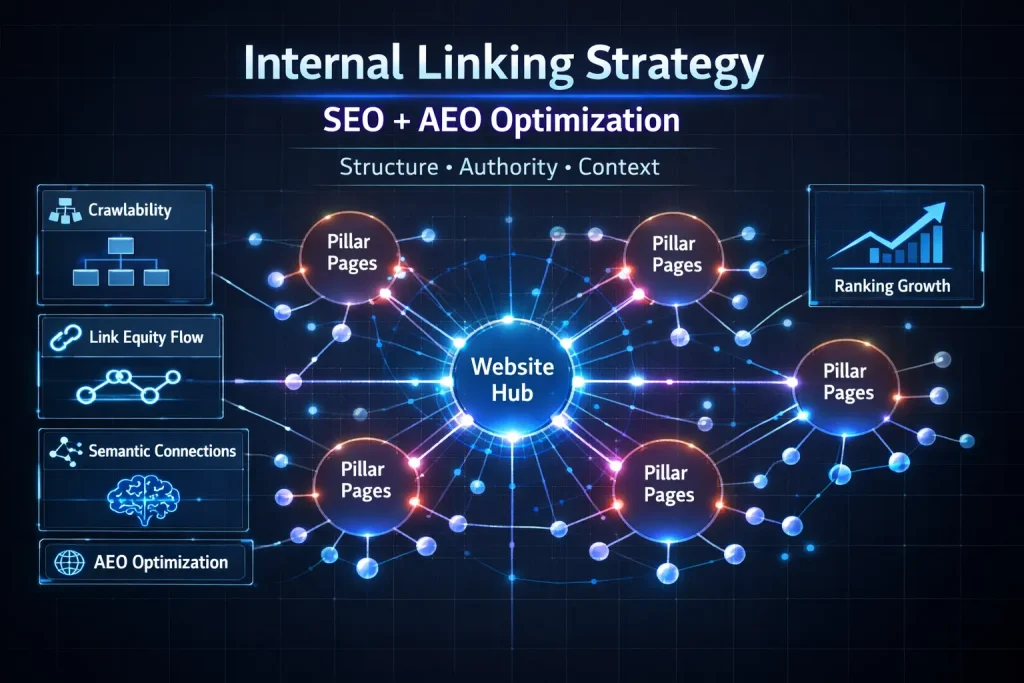
For modern websites, especially service-based businesses, internal linking is no longer just about navigation. It is about creating a structured content ecosystem where every page supports another. A strong internal linking strategy improves crawlability, distributes authority, and helps both search engines and AI systems interpret your content more effectively. This becomes even more critical with the rise of Answer Engine Optimization (AEO), where structured content directly influences AI-generated answers.
Why Internal Linking Is Important for SEO & AEO
Internal linking is one of the most powerful yet underutilized SEO techniques. It helps search engines discover new pages, understand relationships between topics, and assign value across your website. Without a proper internal link structure, even high-quality content may struggle to rank.
From an AEO perspective, internal links help AI systems connect related information, identify key topics, and extract precise answers. This means your internal linking strategy directly impacts your visibility not only in search engines but also in AI-driven search environments.
How Search Engines and AI Understand Internal Links
Search engines like Google use internal links to crawl and index your website efficiently. They follow links to discover new pages and analyze how those pages are connected. AI systems go beyond this by evaluating context, meaning, and semantic relationships between pages.
Understanding how both systems interpret internal links allows you to build a strategy that improves rankings while also preparing your site for future search trends.
Crawlability and Indexing
- Helps search engines find and index pages faster
- Ensures important pages are not missed
- Improves overall site visibility
Link Equity Distribution
- Passes authority from high-value pages to others
- Strengthens weaker pages
- Improves ranking potential across the site
Semantic Relationships and Context
- Connects related topics
- Helps search engines understand content depth
- Improves topical authority
Types of Internal Links You Must Use
Not all internal links serve the same purpose. A well-structured strategy includes different types of links that guide both users and search engines through your content. Using a balanced combination ensures maximum SEO impact and better user experience.
Each type of link plays a specific role in improving navigation, authority distribution, and content relevance.
Navigational Links
- Found in menus and headers
- Help users move across main pages
- Define site structure
Contextual Links
- Placed within content
- Connect related topics naturally
- Carry the highest SEO value
Footer and Sidebar Links
- Provide additional navigation
- Support deep page discovery
- Reinforce site hierarchy
Keyword Research for Internal Linking Strategy
Internal linking should always align with your keyword strategy. Linking pages based on keyword relevance helps search engines understand which pages should rank for specific queries. This is especially important for building topical authority and improving keyword rankings.
By mapping keywords to specific pages, you can create a structured linking system that strengthens your entire website.
Primary Keyword Mapping
- Assign main keywords to core pages
- Avoid keyword cannibalization
- Define page purpose clearly
Supporting Keyword Linking
- Use secondary keywords like “internal linking for SEO” and “internal links optimization”
- Connect related pages naturally
- Strengthen keyword relevance
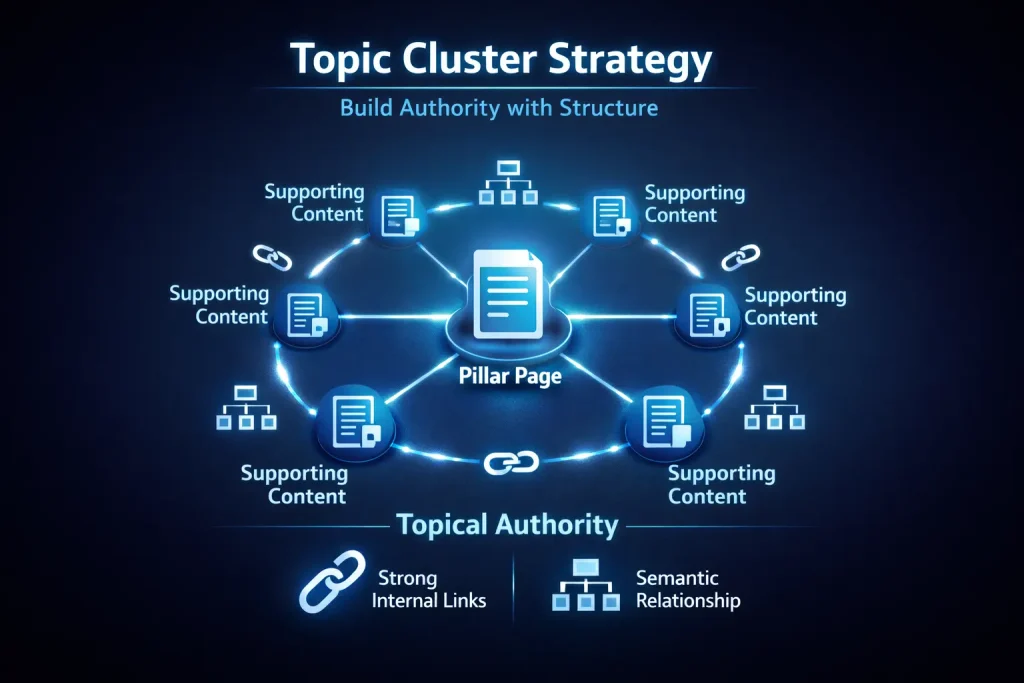
Topical Cluster Strategy
- Group related content into clusters
- Link all supporting pages to a main pillar page
- Improve overall authority
Building a Strong Internal Linking Structure
A strong internal link structure ensures that authority flows efficiently throughout your website. It helps search engines prioritize important pages and improves user navigation. Without a clear structure, your SEO efforts may become fragmented and less effective.
Strategic linking ensures that both users and search engines can easily access your most valuable content.
Homepage Linking Strategy
- Link to key service and category pages
- Highlight important content
- Distribute authority effectively
Service Page Linking
- Link to related services
- Connect to relevant blog content
- Improve conversion pathways
Blog to Service Linking
- Drive traffic from informational content
- Use contextual internal linking
- Improve lead generation
Topic Cluster Model
- Create pillar pages for main topics
- Link supporting articles
- Build strong content hierarchy
Internal Linking Strategy for AEO (Future SEO Advantage)
Answer Engine Optimization requires a more advanced approach to internal linking. Instead of just linking pages, you must create meaningful relationships between topics, entities, and user intent. This helps AI systems understand your content and deliver it as direct answers.
A well-optimized internal linking strategy for AEO can significantly improve your chances of appearing in featured snippets, AI summaries, and voice search results.
Entity-Based Linking
- Connect pages around key entities
- Strengthen semantic relevance
- Improve AI understanding
Semantic Content Connections
- Link related concepts, not just keywords
- Build contextual relationships
- Enhance content depth
Optimizing for Featured Snippets
- Link to concise answer sections
- Support structured content
- Improve snippet eligibility
Structuring Content for AI Answers
- Use clear headings and sections
- Link supporting content logically
- Improve answer extraction
Anchor Text Optimization Strategy
Anchor text is a critical component of internal linking. It tells search engines what the linked page is about and influences how that page ranks. Poor anchor text can weaken your internal linking strategy, while optimized anchors can significantly improve results.
A balanced approach ensures that your links appear natural while still being optimized for SEO.
Exact Match Anchors
- Use the primary keyword strategically
- Avoid overuse to prevent penalties
Partial Match Anchors
- Include variations like “internal linking strategy”
- Maintain natural flow
Natural Anchor Text
- Use generic phrases where appropriate
- Keep content readable and user-friendly
Why Your Website Needs a Blog for Internal Linking
A blog is essential for building a strong internal linking strategy. It allows you to create multiple content pieces targeting different keywords and connect them to your core pages. This improves both SEO performance and user engagement.
Blogs also help expand your keyword reach, making it easier to rank for long-tail queries. By linking blog posts to service pages, you can drive targeted traffic and improve conversions.
Common Internal Linking Mistakes
Many websites fail to achieve results because of poor internal linking practices. Identifying and fixing these mistakes is crucial for improving SEO performance and maximizing the impact of your strategy.
Avoiding these errors ensures that your internal linking efforts contribute positively to rankings and user experience.
Orphan Pages
- Pages with no internal links
- Difficult for search engines to find
- Poor ranking potential
Over-Optimization of Anchors
- Excessive use of exact match keywords
- Looks unnatural to search engines
- Can reduce effectiveness
Too Many Links on One Page
- Dilutes link value
- Confuses users
- Reduces clarity
Irrelevant Linking
- Linking unrelated pages
- Weakens topical relevance
- Hurts SEO performance
Final Thoughts
An effective internal linking strategy is a foundational element of both SEO and AEO. It improves crawlability, strengthens keyword relevance, and enhances user experience. More importantly, it prepares your website for the future of search, where AI-driven systems play a major role in content discovery.
Businesses that invest in structured internal linking will not only achieve better rankings but also build long-term authority in their niche. As competition increases, a well-optimized internal linking structure can become a decisive advantage.
FAQs about Internal Linking Strategy
1. What is an internal linking strategy?
It is the process of linking pages within your website to improve navigation, SEO, and content relationships.
2. How does internal linking help SEO?
It improves crawlability, distributes authority, and helps search engines understand your content structure.
3. What is the ideal number of internal links per page?
There is no fixed number, but links should be relevant and not excessive.
4. How does internal linking support AEO?
It helps AI systems connect content and extract accurate answers based on context.
5. What is anchor text in internal linking?
Anchor text is the clickable text used in a link that describes the linked page.
6. How do I find internal linking opportunities?
By analyzing existing content and connecting related topics using relevant keywords.
7. Can internal linking improve rankings quickly?
It can provide noticeable improvements, but results depend on overall SEO strategy.