
Secrets of Social Media Marketing for Small Businesses
Social media marketing for small businesses works best when it follows a simple, repeatable system. Instead of posting on every platform or chasing every trend, small business owners should focus on the channels their audience actually uses, create helpful content, respond to customers, and connect each post to a clear goal such as awareness, leads, or sales. That is what makes social media both manageable and profitable.
This guide explains the core strategy in a practical way, so busy teams can choose the correct platforms, plan content consistently, and measure what matters. If you want a realistic approach that fits a limited budget and limited time, this article shows how to build one that supports real business growth over time.
What Makes Social Media Marketing Successful for Small Businesses?
The real secret is not posting more. It is building a maintainable system. Small businesses succeed by focusing on a narrow audience, choosing a few strong platforms, publishing useful content consistently, and connecting activity to business results such as inquiries, bookings, purchases, or repeat customers. This pattern is present across the strongest competitor pages, even if they express it differently.
In other words, successful social media marketing is less about volume and more about discipline. A business posting three useful, relevant updates each week with a clear purpose usually outperforms one that posts randomly every day without a plan. For small teams, simplicity is an advantage.
A simple success formula looks like this:
- know exactly who you want to reach
- Choose the platforms they already use
- Create content that answers questions or shows value.
- Engage like a real person,
- review results, and improve gradually
This foundation enables long-term growth: focus on a clear audience, use suitable platforms, answer questions, interact authentically, and review results to refine your approach. These are the key takeaways for managing social media effectively.
What Social Media Marketing for Small Businesses Really Means
Social media marketing for small businesses means using social platforms to attract attention, build trust, stay visible, and encourage meaningful action. Depending on the business, that action could be a message, a quote request, a booking, a product sale, a website visit, or a repeat purchase. Salesforce describes it as using social platforms to connect with customers, build awareness, drive traffic, and generate leads. Adobe, Oklahoma State, and Hootsuite all frame it similarly.
It also includes more than posting. For a small business, social media marketing involves choosing suitable platforms, planning content, responding to comments and messages, encouraging reviews and user-generated content, and tracking what actually works. The businesses that treat social media as an ongoing customer relationship channel tend to get more value from it than those that treat it like an electronic flyer board.
Why Social Media Marketing Matters for Small Businesses Today
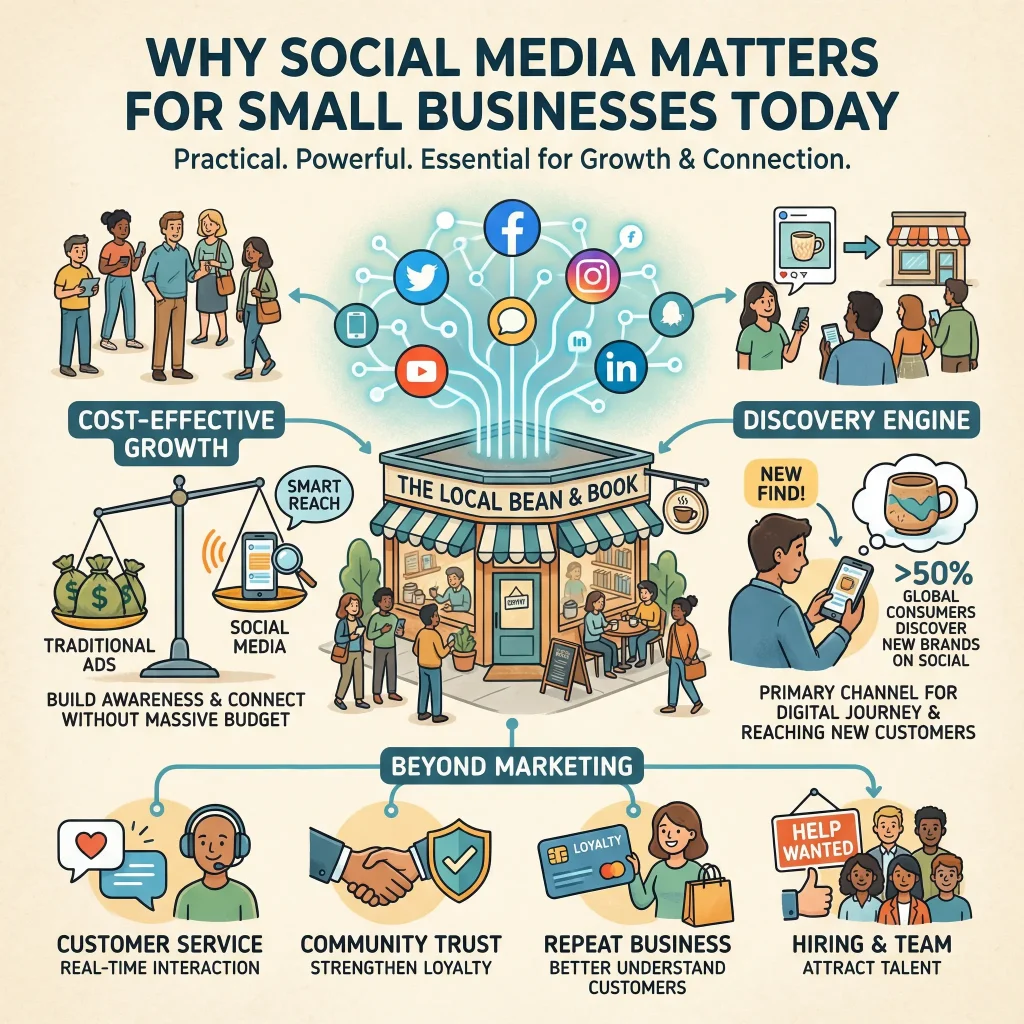
Social media matters because it gives small businesses a practical way to compete for attention without needing a massive advertising budget. Hootsuite calls it one of the most cost-effective ways for small businesses to build awareness and connect with the right audience, and Adobe also describes it as a cost-effective channel for reaching customers and growing brand awareness.
It also matters because discovery increasingly happens on social platforms. Hootsuite reports that more than half of global consumers discovered a new brand or product on social in the last six months. Adobe says social can help businesses reach new customers, while Sprinklr emphasizes that social is often a primary channel for discovery and engagement in the digital customer journey.
For small businesses specifically, social media isn’t just a marketing channel. It supports customer service, community trust, repeat business, and even hiring. Oklahoma State highlights real-time customer interaction and analytics, while Adobe notes that active communication helps businesses better understand their customers and strengthen loyalty.
Types of Social Media Marketing Strategies
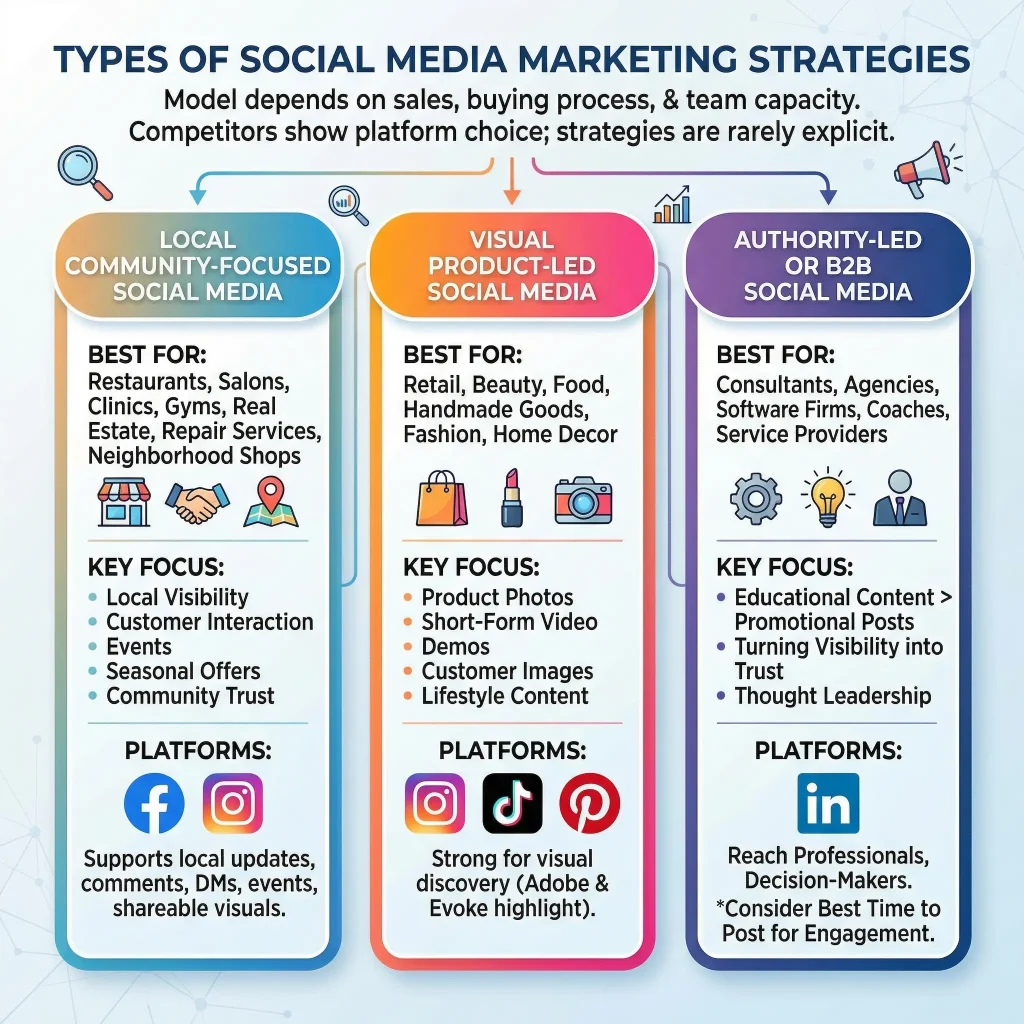
Not every small business needs the same kind of social strategy. The best model depends on what you sell, how people buy from you, and what your team can realistically create. Competitor pages often explain platform choice, but they rarely make the strategy types this explicit.
Local Community-Focused Social Media
This works best for restaurants, salons, clinics, gyms, real estate professionals, repair services, and neighborhood shops. The focus is on local visibility, customer interaction, events, seasonal offers, and community trust. Facebook and Instagram often work well here because they support local updates, comments, DMs, events, and shareable visuals.
Visual Product-Led Social Media
This is ideal for retail, beauty, food, handmade goods, fashion, and home decor. Visual businesses benefit from product photos, short-form video, demos, customer images, and lifestyle content. Adobe and Evoke both highlight Instagram, TikTok, and Pinterest as strong choices when visual discovery matters.
Authority-Led or B2B Social Media
Consultants, agencies, software firms, coaches, and service providers often achieve better results with educational content than with purely promotional posts. LinkedIn is especially useful when your audience includes professionals, decision-makers, and thought leaders, and thought-leadership content can help turn visibility into trust. To strengthen that strategy, it is worth understanding the best Time to post on LinkedIn, so your content reaches the right people when they are most likely to engage.
Video-First Discovery Social Media
If your business can demonstrate products, show personality, or describe things clearly on camera, short-form video can become a major growth lever. Evoke highlights short-form video as a strong discovery format, and Adobe notes that TikTok, Instagram, and YouTube each reward interesting video content differently.
Search-Supported Social Media
This is one of the most overlooked opportunities. Evoke says users increasingly search within platforms for businesses, services, and solutions, while Sprinklr recommends tracking customer questions, keywords, and trending topics. That means your captions, profile descriptions, FAQs, and educational posts can help people discover you even if they weren’t already following you.
Key Benefits of Social Media Marketing
One major benefit is visibility. A strong social presence helps people remember your business, discover your offer, and stay aware of what you do. Adobe, Salesforce, and Hootsuite all emphasize brand awareness as a core benefit.
Another benefit is clear interaction. Social gives small businesses a way to answer questions, respond to feedback, build trust, and show personality in real time. That human element matters, especially for smaller brands competing against bigger names with larger budgets.
Then there is performance value. Social can drive traffic, leads, store visits, purchases, and repeat business when content fits the audience’s needs. It also provides faster feedback than many traditional channels, helping small teams improve more quickly.
Common Problems and Limits Small Businesses Should Know
One big mistake small businesses make is trying to use every social media platform at once. This is not a good idea. It is better to do well on 2 platforms than to do badly on 6 platforms.
Another problem is posting without a clear goal. A business should first decide what it wants. Does it want more people to know about it, more website visitors, more customers, or more sales? Without a goal, it is hard to know if the work is successful.
There is also a risk in depending only on social media. Social media rules and algorithms can change at any time. Because of this, businesses should also create their own content, like blog posts, guides, emails, and landing pages. If these show up on Google, more people can find the business. SEO services can also help bring more visitors from Google.
Best Practices for Building a Strong Small Business Social Media Presence
Choose Fewer Platforms and Use Them Better
You do not need to be active everywhere. Adobe, Evoke, and Oklahoma State all recommend selecting platforms based on audience fit and content suitability. A focused strategy is easier to maintain and usually produces higher-quality content.
Build Around Customer Questions
If you do not know what to post, start with what customers already ask. Sprinklr recommends identifying customer questions, keywords, and search behavior. Posts that explain, compare, teach, or elaborate tend to do more than generic “buy now” updates because they align with real intent.
Keep Your Content Mix Balanced
Not every post should sell. A healthy mix usually includes educational posts, insider content, customer proof, product or service highlights, and community or seasonal updates. Evoke’s content pillar model and Adobe’s “common mistakes” section both underscore the value of having a real plan rather than posting at random.
Engage Like a Human
Reply to comments, answer messages, thank customers, and stay present. Oklahoma State highlights real-time engagement, while Hootsuite and Evoke both emphasize authentic engagement instead of robotic broadcasting. Small businesses often win because they can sound more personal than bigger brands.
Measure What Matters
Monitor metrics that match your business goals. To maximize success, focus on the following takeaways: choose the right platforms, answer customer questions, balance your content mix, engage genuinely, and measure meaningful results. These steps confirm your efforts support real business growth.
How to Build a Simple Social Media Marketing System Step by Step
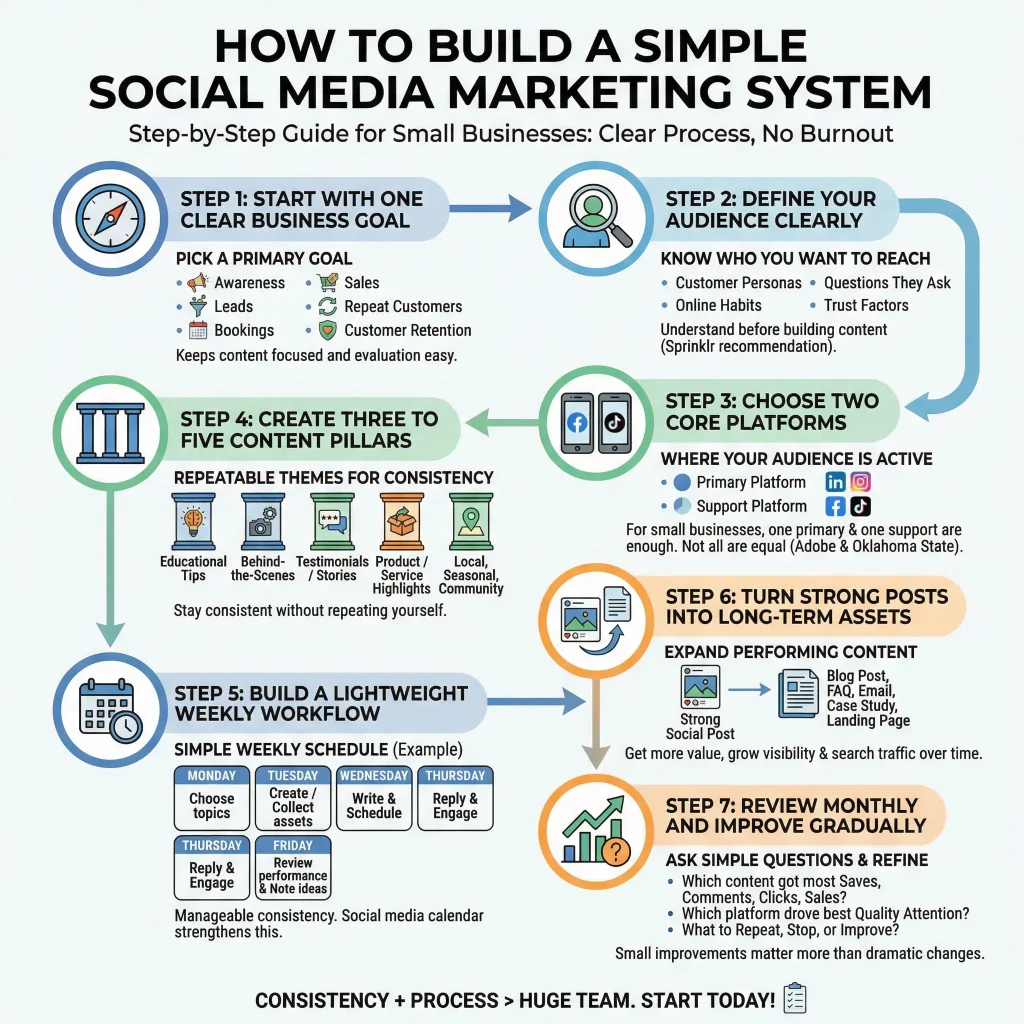
The best system for a small business is the one you can repeat without burning out. You do not need a huge team. You need a clear process. The strongest competitor pages all point in this direction, but most stop short of turning it into a truly usable weekly system.
Step 1: Start With One Clear Business Goal
Pick a primary goal first: awareness, leads, bookings, sales, repeat customers, or customer retention. This keeps your content focused and makes performance easier to evaluate later.
Step 2: Define Your Audience Clearly
Know who you want to reach, what they care about, what questions they ask, and what would make them trust you. Sprinklr specifically recommends understanding customer personas, online habits, questions, and keywords before building content.
Step 3: Choose Two Core Platforms
Pick the platforms where your audience is active and where your content can work naturally. For many small businesses, a primary platform and one support platform are enough. Adobe and Oklahoma State both stress that not every platform will be equally effective for every business.
Step 4: Create Three to Five Content Pillars
A small business usually does well with a few repeat themes. Good pillars often include:
- educational tips
- behind-the-scenes content
- testimonials or customer stories
- product or service highlights
- local, seasonal, or community content
This kind of structure helps you stay consistent without repeating yourself.
Step 5: Build a Lightweight Weekly Workflow
A simple workflow could look like this:
- Monday: choose topics
- Tuesday: create or collect assets
- Wednesday: write and schedule
- Thursday: reply and engage
- Friday: review performance and note ideas
This is manageable for a small team and still gives you consistency. A social media content calendar can strengthen that process by helping you organize content ideas, schedule publishing dates, manage engagement tasks, and review performance in a more structured way. It also reflects the planning, publishing, engagement, and optimization rhythm emphasized across leading competitor guides.
Step 6: Turn Strong Posts Into Long-Term Content Assets
If a topic performs well on social, do not let it disappear after a few days. Expand it into a blog post, FAQ, email, case study, or landing page. That is one of the smartest ways to get more value from your best ideas, especially if your goal is to grow both social visibility and search traffic over time. The approach is also consistent with your 5-page, which emphasizes turning expertise into traffic, authority, and qualified leads through structured content.
Step 7: Review Monthly and Improve Gradually
At the end of each month, ask simple questions: Which content got the most saves, comments, clicks, or sales? Which platform drove the best quality attention? What should you repeat, stop, or improve? Small improvements over time usually matter more than dramatic changes every week.
How Social Media Marketing Supports Search Visibility and Content Discovery
Social media is no longer just a place where people scroll passively. People also search inside platforms for businesses, topics, local services, reviews, and how-to content. Evoke says this directly, and Sprinklr recommends aligning social content with the keywords and questions your audience already uses.
That means your profile, captions, headlines, video titles, and FAQ-style posts should use clear, natural language. If you are a bakery, say what kind of bakery you are. If you are a consultant, say what problem you solve. If you are a cleaning brand, clearly name the service. This helps people, search systems, and AI tools understand what you do faster. That clarity also supports stronger on-site content when you expand your best social ideas into blog articles.
A practical way to think about this is simple: social helps you get discovered quickly, while owned content helps you get discovered consistently. The strongest long-term strategy uses both.
Real Examples of Social Media Marketing for Different Small Business Types
Local Bakery
A bakery can use Instagram and Facebook to post new products, customer photos, short preparation clips, holiday items, and same-day offers. Local references, comments, and story-based updates help turn casual viewers into repeat customers. This approach fits the community and visual strategy patterns highlighted across Adobe, Oklahoma State, and Evoke.
B2B Consultant or Small Agency
A consultant can use LinkedIn plus blog content to build authority. Short frameworks, client lessons, practical tips, and answer-based posts often work better than constant self-promotion. If a post gains traction, it can become a longer article or a lead magnet. That strategy fits well with the authority-building and search-support model described by competitor pages and your internal blog-writing page.
Small eCommerce Brand
An eCommerce business can use Instagram or TikTok for product discovery, then move traffic to product pages, email signup offers, or evergreen blog content. Product demos, customer reviews, unboxings, creator-style videos, and FAQs are especially useful because they combine trust, entertainment, and buying intent.
Final Thoughts
The real secret to social media marketing for small businesses is not chasing every trend or trying to look like a giant brand. It is building a practical system that fits your audience, your offer, and your available time. When you choose the right platforms, answer real customer questions, engage consistently, and review what actually drives business results, social media becomes easier to manage and much more useful.
The businesses that win are usually not the loudest. They are the clearest, the most consistent, and the most helpful. That is what turns social activity into trust, and trust into growth. If you want to extend that growth beyond the feed, Social Media Blog Writing Services can help you turn social momentum into long-term content value.
FAQ
Is social media marketing worth it for a small business?
Yes. Social media marketing helps small businesses build awareness, reach new customers, strengthen trust, and support sales without needing a large budget.
Which social media platform should a small business start with?
A small business should start with the platform its customers already use most. Instagram often works well for visual brands, while LinkedIn is stronger for many B2B businesses.
How often should a small business post on social media?
A small business should post consistently. For many teams, posting a few times per week on one or two core platforms is a realistic starting point.
What should a small business post about on social media?
A small business should post educational tips, customer stories, behind-the-scenes content, product or service highlights, and local or seasonal updates.
Do small businesses need a social media calendar?
Yes. A simple social media calendar helps small businesses stay consistent, plan content in advance, and manage posting with less stress.
Can one person manage social media for a small business?
Yes. One person can manage social media if the strategy is simple, focused, and built around a realistic weekly workflow.
Should a small business start with organic social media or paid ads?
Most small businesses can start with organic social media first. Paid ads can be added later to expand the reach of content that already performs well.
How do I know if my social media marketing is working?
Track the metrics that match your goal. Use reach for awareness, engagement for interest, and clicks, inquiries, or sales for business results.
Do small businesses need to be on every social media platform?
No. Small businesses usually achieve better results by focusing on a few platforms that align with their audience and content style.
What is the biggest social media mistake small businesses make?
One of the biggest mistakes is posting without a clear goal or schedule. Inconsistent posting and random content usually lead to weak results.

