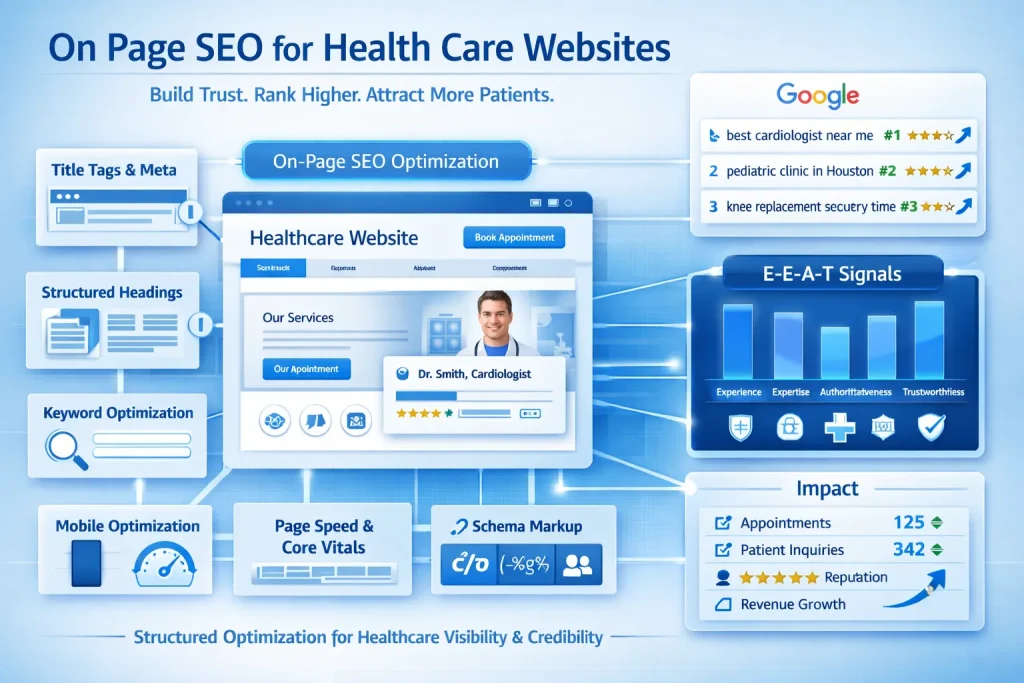
If you run a healthcare website, whether it’s a hospital, clinic, private practice, or health tech platform your website isn’t just marketing.
It’s trust.
And in healthcare, trust directly impacts:
- Appointment bookings
- Patient inquiries
- Online reputation
- Revenue
That’s why On Page SEO for Health Care Websites isn’t optional anymore.
It’s foundational.
With Google treating healthcare as a Your Money or Your Life (YMYL) category, the standards are higher. You don’t just need keywords. You need credibility, clarity, and compliance — all structured properly.
Let’s break it down step by step.
Why On-Page SEO Matters More in Healthcare Than Other Industries
Healthcare SEO is different.
When someone searches:
- “best cardiologist near me”
- “symptoms of thyroid disorder”
- “pediatric clinic in Houston”
- “knee replacement surgery recovery time”
They’re not casually browsing. They’re making decisions that affect their health.
Google knows this.
That’s why it emphasizes E-E-A-T:
- Experience
- Expertise
- Authoritativeness
- Trustworthiness
Strong healthcare website on-page SEO best practices help demonstrate these signals clearly. Without proper optimization, even the best medical content can stay invisible.
Core On-Page SEO Elements for Healthcare Websites
Let’s start with the fundamentals of log writing with proper On page SEO. These are non-negotiable.
1. Optimized Title Tags & Meta Descriptions
Your title tag is the first impression in search results.
Instead of:
Home | ABC Clinic
Use:
Family Health Clinic in Dallas | ABC Medical Center
Make sure your title:
- Includes primary keyword naturally
- Includes location (if applicable)
- Stays under ~60 characters
Your meta description should:
- Address patient intent
- Include trust signals
- Stay under 160 characters
For example:
Board-certified pediatricians in Dallas offering same-day appointments. Compassionate care for your child’s health needs.
Clear. Trust-focused. Click-worthy.
2. Proper Heading Structure (H1, H2, H3)
Many healthcare sites make this mistake:
Multiple H1s.
No structured hierarchy.
Keyword stuffing in subheadings.
Instead:
- One H1 per page
- Logical H2s for main sections
- H3s for supporting details
For example on a cardiology page:
H1: Cardiologist in Chicago
H2: Our Cardiology Services
H2: Conditions We Treat
H2: Meet Our Board-Certified Cardiologists
H2: Schedule an Appointment
Structure improves readability and SEO.
3. Strategic Keyword Placement (Without Overdoing It)
When optimizing healthcare content:
Use keywords naturally in:
- First 100 words
- Subheadings
- URL
- Image alt text
- Internal links
Avoid writing like this:
Our healthcare website SEO strategy for healthcare websites…
Google is smarter than that.
Focus on intent, not repetition.
Optimizing URLs, Images & Multimedia
These are often overlooked but they matter.
Clean, Search-Friendly URLs
Bad:
website.com/page?id=123
Good:
website.com/cardiology-services-chicago
Keep URLs:
- Short
- Descriptive
- Keyword-aligned
Image Optimization for Healthcare SEO
Medical websites use lots of images:
- Doctor profiles
- Facility images
- Treatment visuals
- Infographics
Each image should include:
- Descriptive file name (e.g., pediatric-dentist-houston.jpg)
- Alt text describing the image
- Compressed size for speed
Alt text also improves accessibility — which is critical in healthcare.
Internal Linking Strategy for Medical Websites
Internal linking helps both:
- Search engines understand site structure
- Patients navigate easily
Example:
From a blog post about diabetes symptoms → link to your endocrinology service page.
From a cardiology service page → link to heart health blog articles.
This distributes authority and improves topical relevance.
Healthcare SEO tips always include internal linking yet most clinics ignore it.
Mobile Optimization & Page Speed: Non-Negotiable in Healthcare
Over 60% of healthcare searches happen on mobile devices.
If your site:
- Loads slowly
- Has tiny fonts
- Has hard-to-click buttons
Patients will leave. And Google notices.
To optimize healthcare website for SEO:
- Use responsive design
- Compress images
- Improve Core Web Vitals
- Reduce unnecessary scripts
Speed builds trust.
Slow sites damage credibility.
Accessibility & Compliance in Healthcare SEO
Healthcare websites must be accessible.
This isn’t just ethical — it supports SEO.
Ensure:
- Proper contrast ratios
- Alt text for images
- Keyboard navigation
- Screen reader compatibility
Also, display:
- Privacy policies
- HIPAA compliance statements (if applicable)
- Secure HTTPS protocol
Trust signals directly impact user behavior and rankings.
Advanced On-Page Optimization for Healthcare Services
Once fundamentals are covered, move to advanced strategies.
Schema Markup for Healthcare Websites
Structured data helps search engines understand:
- Medical organization details
- Physician credentials
- Reviews
- FAQs
Use:
- MedicalOrganization schema
- Physician schema
- FAQ schema
This can enhance search results with rich snippets.
Content Depth & Medical Accuracy
Healthcare content must:
- Be factually accurate
- Cite credible sources
- Be reviewed by qualified professionals
Add:
- Author bio with credentials
- Medical reviewer information
- Date last updated
This supports E-E-A-T.
Service Page Optimization Strategy
Each service page should include:
- Clear description of treatment
- Symptoms addressed
- Procedure explanation
- FAQs
- Internal links
- Clear call to action
This improves both rankings and conversions.
Common On-Page SEO Mistakes in Healthcare
After auditing dozens of healthcare sites over 10 years, here’s what I see most often:
❌ Thin Service Pages
300-word pages won’t rank in competitive markets.
❌ Duplicate Meta Tags
Every page must have unique titles and descriptions.
❌ No Local Signals
Missing location references for clinics.
❌ Overly Technical Language
Patients need clarity, not medical jargon overload.
❌ Ignoring Content Updates
Medical information changes. Update regularly.
Step-by-Step On-Page SEO Checklist for Healthcare Websites
Here’s a practical checklist you can implement:
- Audit title tags & meta descriptions
- Fix heading structure
- Improve keyword placement naturally
- Optimize URLs
- Add descriptive alt text to all images
- Strengthen internal linking
- Improve mobile performance
- Add schema markup
- Update outdated medical content
- Add clear CTAs to every service page
Consistency is key.
Final Thoughts
If you want your healthcare website to rank — and more importantly, earn patient trust — on-page SEO must be strategic.
It’s not about stuffing keywords.
It’s about:
- Clear structure
- Accurate content
- Technical optimization
- Trust signals
- Excellent user experience
Mastering On Page SEO for Health Care Websites positions your brand as credible, visible, and reliable in one of the most competitive digital industries.
And in healthcare, visibility isn’t just traffic.
It’s impact.
FAQs About On Page SEO for Health Care Websites
What are the most important on-page SEO factors for healthcare?
Title tags, content quality, internal linking, mobile optimization, and E-E-A-T signals are critical.
Why is E-E-A-T important for medical websites?
Healthcare content affects real-life decisions. Google prioritizes expertise and trustworthiness.
How often should healthcare websites update content?
At least every 6–12 months, or when medical guidelines change.
Can small clinics compete with large hospitals in SEO?
Yes — with strong local optimization and well-structured on-page SEO strategy.