
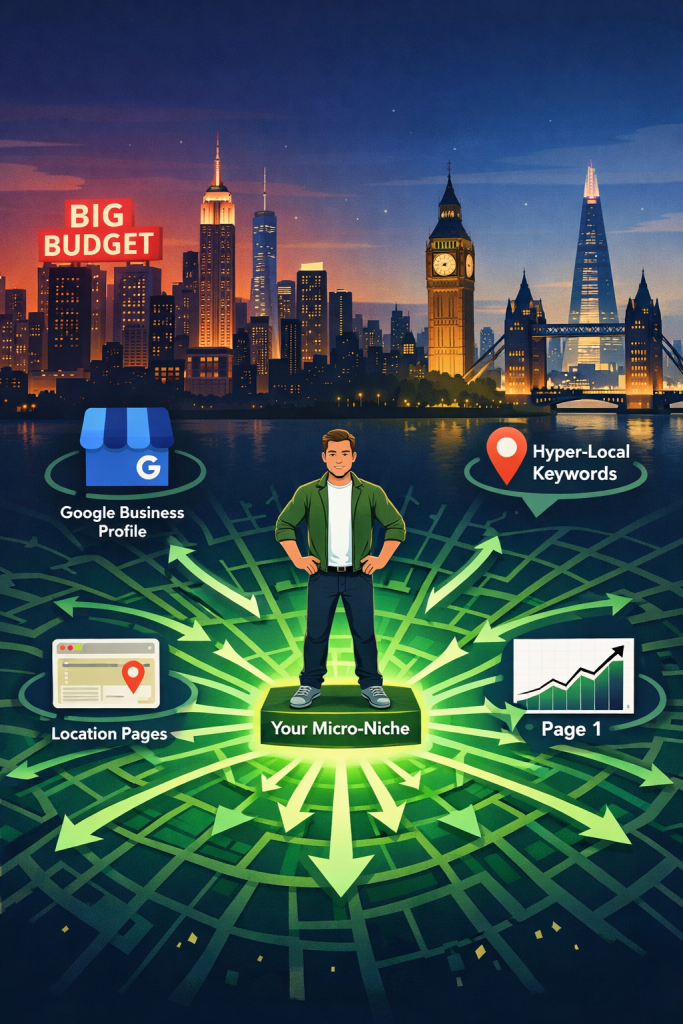
Big cities are SEO battlegrounds. In London, New York, or Dhaka, thousands of businesses are fighting for the same 10 spots on page one. Why are big cities so competitive? Higher search volume, higher customer value, and national brands with massive budgets all targeting the same “city + service” keywords.
Why traditional SEO does not work here? Basic SEO — a homepage, a blog, and a few backlinks — worked in 2018. Today, everyone is doing it. Google now rewards depth, locality, and trust, not just keywords.
The challenge for local startups is simple: you can’t outspend, so you have to out-smart.In this guide, you’ll learn 9 low-cost, hyper-local strategies that help startups win in the most competitive markets.
Why Local SEO Is Critical for Startups
For startups, visibility is one of the biggest challenges. People may need your product or service, but if they cannot find your business online, they will choose a competitor instead. This is why local SEO is so important.
Local SEO helps startups appear in searches made by people in a specific area. Instead of competing with businesses everywhere, startups can focus on reaching potential customers nearby. This makes SEO more practical, affordable, and effective.
1. What Is Local SEO
Local SEO is the process of improving your online presence so your business can rank in location-based searches. These are searches where people are looking for services, shops, or businesses in a specific city, area, or nearby location.
Examples include:
- “coffee shop near me”
- “digital marketing agency in Dhaka”
- “best dentist in Brooklyn”
These searches are highly valuable because they show clear local intent. The user is not just browsing for information—they are often looking for a business they can contact or visit soon.
This is why “near me” and city-based searches matter so much. Google tries to show the most relevant local results, often through Google Maps and local business listings. If your startup is properly optimized, it has a much better chance of appearing in front of these potential customers.
2. Why Local SEO Works in Cities
Local SEO is especially effective in cities because people often search for businesses close to where they live, work, or travel. In large urban areas, convenience matters. Customers usually prefer nearby options that are easy to reach and quickly available.
For startups, this creates a strong opportunity. First, local SEO helps you target nearby customers instead of trying to reach everyone. This means your marketing becomes more focused and relevant.
Second, local search usually brings higher-intent traffic. Someone searching for “SEO agency near me” or “bakery in Gulshan” is much closer to taking action than someone searching a broad term like “SEO tips” or “cake ideas.”
Third, local SEO often has less competition than global SEO. Competing for a broad keyword on a national or global level can be extremely difficult for a startup. But targeting a specific city, neighborhood, or service area makes ranking more realistic.
For these reasons, local SEO is one of the most valuable growth strategies for startups operating in competitive cities. It helps attract relevant traffic, improves visibility, and supports long-term business growth.
The Biggest Challenge: High Competition
The biggest challenge in city SEO is high competition.
In large cities, many businesses target the same keywords. Big brands and established companies often dominate search results because they have stronger websites, more content, and higher authority.
Keywords like “marketing agency New York,” “best gym London,” or “lawyer in Toronto” are very difficult for startups to rank for.
Another problem is that most businesses already use basic SEO. They have websites, blogs, Google Business Profiles, and customer reviews. This makes simple SEO tactics much less effective.
Generic SEO strategies often fail in cities because:
- Broad city keywords are highly competitive
- Big brands have stronger domain authority
- Many businesses publish similar content
- Customers have more choices, so trust matters more
That is why startups need a smarter, more focused local SEO strategy to compete successfully.
Strategy 1: Niche Down to Win
Stop trying to be everything to everyone.
1. Target Micro-Niches
Instead of “personal trainer NYC,” target:
- “fitness coach for women NYC”
- “postnatal fitness trainer Upper East Side”
- “vegan meal prep trainer Brooklyn”
Longer phrases have 10x less competition and 3x higher conversion.
2. Highlight Your Unique Value (USP)
Are you the only 24/7 locksmith in Soho? The only Spanish-speaking dentist in Queens? Put that USP in your title tag, GBP description, and H1s. Google rewards specificity.
Strategy 2: Use Hyper-Local Keywords
In competitive cities, targeting only the city name is often not enough. Broad keywords like “SEO agency New York” or “dentist London” are usually dominated by big companies with stronger websites and larger marketing budgets. For startups, a better approach is to focus on hyper-local keywords.
Hyper-local keywords target smaller areas within a city, such as neighborhoods, districts, landmarks, or nearby places. These searches are more specific, less competitive, and often bring visitors who are ready to take action.
Target Neighborhood Keywords
Large cities are made up of many neighborhoods, and people often search using these local area names instead of the city itself. This gives startups a valuable opportunity to rank in smaller, more targeted search spaces.
Examples include:
- “SEO agency Brooklyn.”
- “coffee shop in Shoreditch”
- “family dentist in Queens”
- “coworking space in Downtown LA”
These keywords are usually easier to rank for than broad city-level terms because they target a narrower location and audience. They also help connect your business with people searching for services in a specific area.
If your startup serves different parts of a city, research the neighborhoods your ideal customers are most likely to search. Then include those terms naturally in your website pages, blog content, service descriptions, and local listings.
2. Use Landmarks and “Near Me” Searches
People do not always search by neighborhood names. In many cases, they search using familiar landmarks, transit stations, popular streets, or phrases like “near me.” These searches are strongly location-based and can help improve your local visibility.
Examples include:
- “restaurant near Central Park”
- “gym near Times Square”
- “digital agency near Canary Wharf”
Adding references to important local places can make your content more relevant to users and search engines. It also helps your business appear more connected to the area you serve.
“Near me” searches are especially important because they often come from users who want immediate solutions. These searchers usually have high intent, which means they are more likely to visit, call, or buy.
Use Landmarks, Transit, and “Near Me” Intent
Over 60% of local searches on mobile are now voice-based “near me.” Google matches these to physical proximity signals.
Build that into your content and GBP:
- “restaurant near Central Park South entrance”
- “gym near Times Square 42nd St station”
- “digital agency near Canary Wharf tube”
- “dentist near NYU campus”
Put the landmark in your:
- Page title tag
- H1 and the first 100 words
- Google Business Profile description
- Image alt text (“team outside Brooklyn Bridge office”)
Optimize Google Business Profile (Your #1 Ranking Asset)
In competitive cities, your GBP drives 50-70% of local leads — not your website. Most startups treat it as a directory listing. Winners treat it like their homepage.
The Full Optimization Checklist:
- Information (Relevance): Fill 100%. Primary category must be exact (“Emergency Dentist” not “Dentist”). Add 5-9 secondary categories. List every service with a 300-word description and price.
- Visuals (Prominence): Upload 100+ high-quality photos. Add exterior, interior, team, before/after, and photos geo-tagged in that neighborhood. Businesses with active photos get 42% more direction requests.
- Activity (Freshness): Post an Update every 7 days — an offer, event, blog, or FAQ. Google rewards active profiles.
- Reviews (Trust): Aim for velocity, not just quantity. 5-10 new reviews per month is the sweet spot. Send an SMS with a direct link right after the service. In your reply, use keywords naturally: “Thanks for choosing our Brooklyn SEO team for your local ranking project!”
- Accuracy: Hours, holidays, attributes (women-led, LGBTQ+ friendly, wheelchair accessible). Wrong hours = ranking drop.
Optimize Google Business Profile
Google Business Profile (GBP) is one of the most powerful tools for local SEO. It helps your startup appear in Google Maps, local search results, and the local pack that often shows above regular website listings.
For businesses in competitive cities, a well-optimized GBP can make a major difference in visibility.
To improve your Google Business Profile:
- Complete all business information
- Choose the correct primary and secondary categories
- Add your services and business description
- Upload high-quality photos of your office, products, or team
- Post regular updates and offers
- Keep your opening hours accurate
- Encourage satisfied customers to leave reviews
- Respond professionally to all reviews
A complete and active profile gives Google more confidence in your business. It also gives users the information they need to trust you and take action.
An optimized Google Business Profile helps startups:
- Appear in local map results
- Improve trust and credibility
- Attract more calls, visits, and website clicks
- Compete more effectively in a crowded local market
Build Location-Specific Pages (The Right Way)
If you serve 5 neighborhoods, you need 5 pages. Not one page with a list.
Wrong way (doorway page): Copy-pasting the same text and just swapping “Brooklyn” for “Manhattan.” Google penalizes this.
Right way (local landing page):
/seo-services-brooklyn//seo-services-manhattan//seo-services-queens/
Each page must be 70% unique and include:
- A unique H1 with neighborhood + pain point (“SEO for Brooklyn E-commerce Startups”)
- A case study from that area with a real address
- Parking, transit directions, and a photo of your team there
- Embedded Google Map
- Local FAQs (“How much does SEO cost in Manhattan?”)
LocalBusiness+Serviceschema with that specific geo-coordinate.
Create Localized Content
Localized content is one of the best ways to stand out in a competitive city. Instead of publishing general blog posts, startups should create content that speaks directly to the problems, interests, and search behavior of local audiences.
This makes your website more relevant to both users and search engines.
8.1 City-Specific Blog Topics
City-focused blog content helps your startup rank for more local keywords while building authority in your market.
Examples include:
- “Top SEO Challenges for Startups in New York”
- “Best Neighborhoods for Coworking in Toronto”
- “How Small Businesses in London Can Improve Local Rankings”
This type of content works well because it connects your expertise with local context. It also helps attract visitors who are looking for information specific to their city or area.
Good localized content can include:
- Local guides
- Area-specific tips
- Common business problems in a city
- Local trends
- Community insights
- Service recommendations for specific neighborhoods
8.2 Content Hubs (Local Clusters)
A stronger strategy is to organize your local content into content hubs.
A local content hub includes:
- One main city or location page
- Several supporting blog posts on related local topics
- Internal links connect all of them together
For example:
Main page: SEO Services in Chicago
Supporting content:
- Local SEO tips for Chicago startups
- How to rank in Chicago neighborhoods
- Best content ideas for Chicago small businesses
This structure helps search engines understand that your website has strong topical relevance for that location. It also improves navigation and keeps visitors engaged longer.
Build Local Authority
In local SEO, authority matters. Google wants to rank businesses that are trusted by other reliable local sources. For startups, building local authority is one of the best ways to compete with bigger brands.
You can build local authority by:
- Getting backlinks from local news websites
- Partnering with nearby businesses
- Sponsoring local events or communities
- Joining city business directories
- Listing your startup in niche directories
- Participating in local forums, associations, or community websites
These links and mentions act as trust signals. They show Google that your business is recognized in the local area.
Quality matters more than quantity. A few links from respected local websites can be far more valuable than many weak or unrelated backlinks.
Local authority helps startups:
- Improve trust in Google’s eyes
- Strengthen local search rankings
- Increase brand visibility in the community
- Stand out in crowded markets
Improve Technical SEO
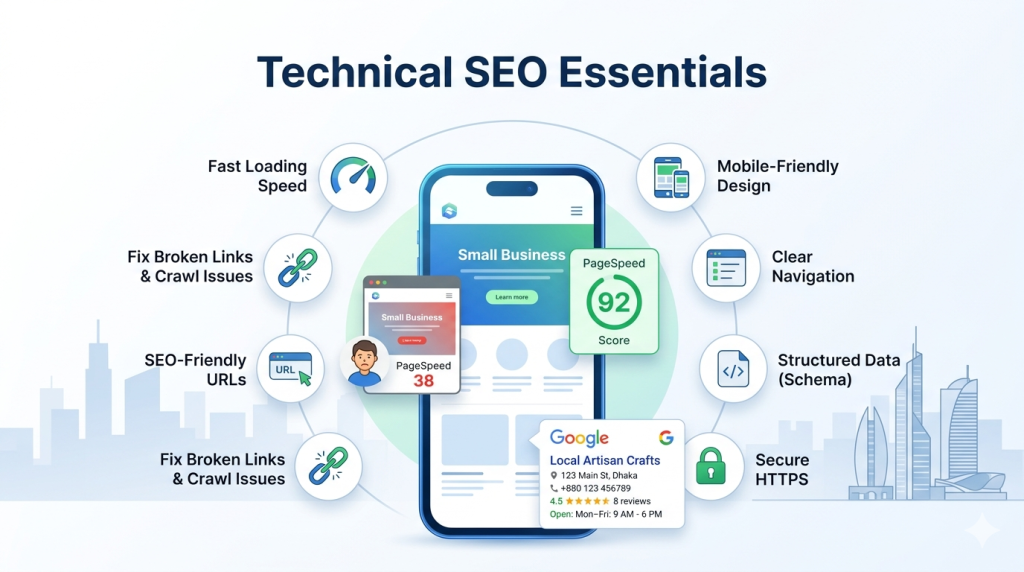
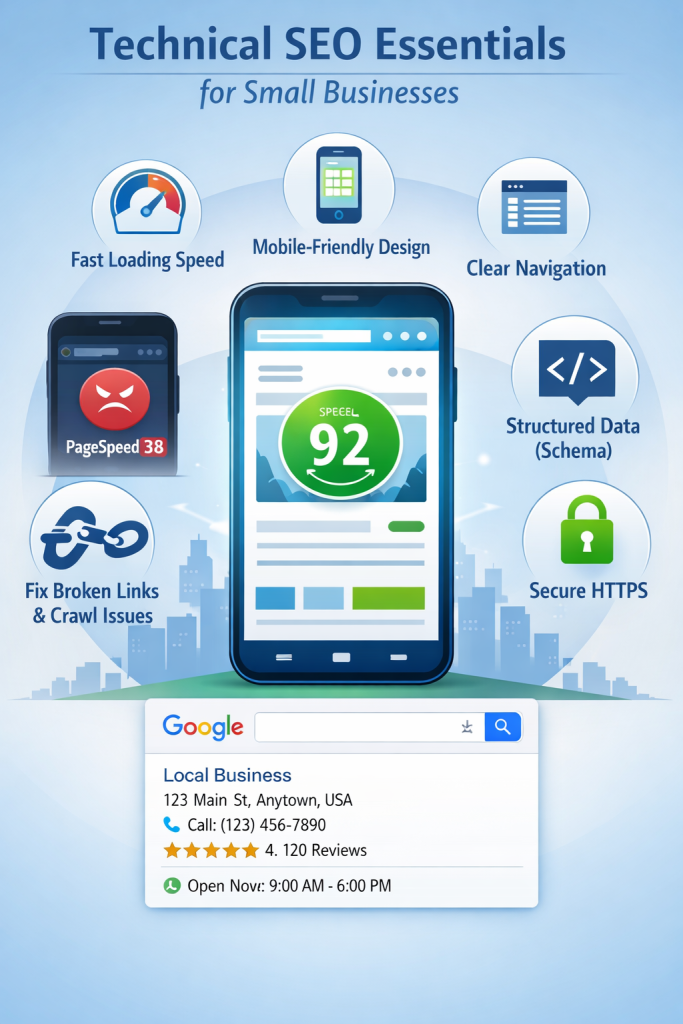
Technical SEO is often ignored by small businesses, but in competitive cities, it can be a major advantage. Even if your content is strong, poor technical performance can hold your rankings back.
Startups should focus on these technical SEO essentials:
- Fast website loading speed
- Mobile-friendly design
- Clear and simple site navigation
- Structured data (schema markup)
- Secure HTTPS connection
- Clean, readable URLs
- Fixing broken links and crawl issues
Website speed is especially important because users in cities often search on mobile devices and expect fast results. A slow website can increase bounce rates and reduce conversions.
Structured data is also useful because it helps search engines understand your business information, including:
- Business name
- Address
- Phone number
- Reviews
- Services
- Opening hours
- Location details
Technical improvements may not always be visible to users, but they strongly affect search performance.
Use Internal Linking
Internal linking is a simple but powerful strategy. It helps search engines understand how your website pages are connected and which pages are most important.
For local SEO, internal linking can support your service pages, location pages, and blog content.
Best practices include:
- Linking blog posts to service pages
- Linking service pages to location pages
- Connecting related blog articles
- Using descriptive and relevant anchor text
For example, if you publish a blog post about local startup SEO, you can link it to a service page targeting “SEO services in Brooklyn.” This improves navigation for users and sends stronger relevance signals to search engines.
Internal links also help distribute authority across your site and support your content hub structure.
A strong internal linking strategy helps startups:
- Improve crawlability
- Strengthen important pages
- Keep users engaged
- Support topical relevance
Focus on Reviews and Trust
Reviews are one of the most important trust signals in local SEO. They influence not only rankings, but also customer decisions.
In competitive cities, users often compare several businesses before choosing one. If your startup has strong reviews and active engagement, it can stand out even against larger competitors.
To improve trust through reviews:
- Ask customers for reviews regularly
- Encourage detailed reviews that mention your service and location
- Respond to both positive and negative reviews
- Highlight customer testimonials on your website
- Keep your business information updated and accurate
Reviews help in several ways:
- They improve visibility in local search
- They build credibility with potential customers
- They provide fresh user-generated content
- They increase click-through and conversion rates
A startup with strong reviews can often compete effectively, even if it has a smaller brand presence.
Common Mistakes to Avoid
Many startups struggle with local SEO because they follow weak or outdated strategies. Avoiding common mistakes can save time and improve results faster.
Here are some of the biggest mistakes:
- Targeting only broad city keywords
- Ignoring neighborhood-level search intent
- Copying competitors instead of creating a unique strategy
- Creating duplicate location pages
- Not updating old content
- Overlooking technical SEO issues
- Failing to collect and manage reviews consistently
These mistakes reduce relevance, limit visibility, and make it harder to compete in crowded markets. A better approach is to build a strategy based on specificity, quality, and local trust.
Conclusion
Startups don’t need a bigger budget to rank in Manhattan or London. They need a narrower focus.
Niche positioning + Hyper-local keywords + GBP mastery + Location pages + Local authority.
Big brands can’t be hyper-local at scale. You can. Own one neighborhood, one micro-niche, one content hub at a time. Track it in Search Console, improve what’s on page 2, and repeat.
In crowded urban markets, smart SEO beats big budgets every time. Consistency is how you go from ranking on one street to owning the entire city.
