

Best Time to Post on LinkedIn for Reach and Leads
Finding the best time to post on LinkedIn is not as simple as choosing one universal hour. Different studies highlight different peaks, but most point to the same starting pattern: LinkedIn posts often perform best on Tuesday, Wednesday, and Thursday during your audience’s local working hours. For brands, founders, and B2B teams, the right posting time depends on your goal, whether that is reach, engagement, or lead generation, but midweek mornings and selected afternoon slots consistently stand out.
This guide brings those patterns into one clear framework, helping you choose smarter posting windows, test them against audience behavior, and turn stronger visibility into more qualified clicks, conversations, and business leads with a repeatable strategy today. It can also help teams align their posting schedule with stronger content planning, especially when supported by Social Media Blog Writing Services that maintain consistent, conversion-focused messaging.
Best Times to Test First
If you need a quick starting point, focus on the posting windows that most consistently support reach and lead generation on LinkedIn.
Why these times: These recommendations are based on overlapping insights from Sprout Social, Taplio, Adobe, Buffer, and LinkedIn.
For reach: Post Tuesday through Thursday between 8:00 a.m. and 11:00 a.m. in your audience’s local time.
For leads: Post Tuesday through Thursday from 9:00 a.m. to 12:00 p.m.
For thought-leadership posts: Test a secondary window on Wednesday or Friday between 3:00 p.m. and 5:00 p.m.
What “Best Time to Post on LinkedIn” Really Means
The best time to post on LinkedIn isn’t a single universal hour. It is a starting window based on three things: your goal, your audience, and your time zone. LinkedIn itself says the topic is not black-and-white and that testing matters because audiences behave differently. Buffer and Sprout also recommend treating platform-wide benchmarks as a starting point rather than a permanent rule.
This inconsistency stems from differing scopes. Sprout’s 2025 report targets Company Pages and shows peak results during weekday business hours. Buffer’s March 2026 analysis finds greater engagement later in the day. Taplio distinguishes between reach and engagement rate, which yields different optimal posting times depending on your objective.
Why Timing Matters for Reach and Leads
Timing matters because LinkedIn is a professional network with a business mindset. LinkedIn says members use the platform to research business topics, build skills, and consume insight-driven content. Timing is key when you want not just likes, but qualified clicks, profile visits, demo interest, or other lead actions.
LinkedIn also stresses responding to engagement in real time, and its posting guides prioritize starting conversations, regular sharing, and analytics to gauge resonance. In short, your posting time influences both your reach and how fast you gain traction.
Best Posting Windows by Goal
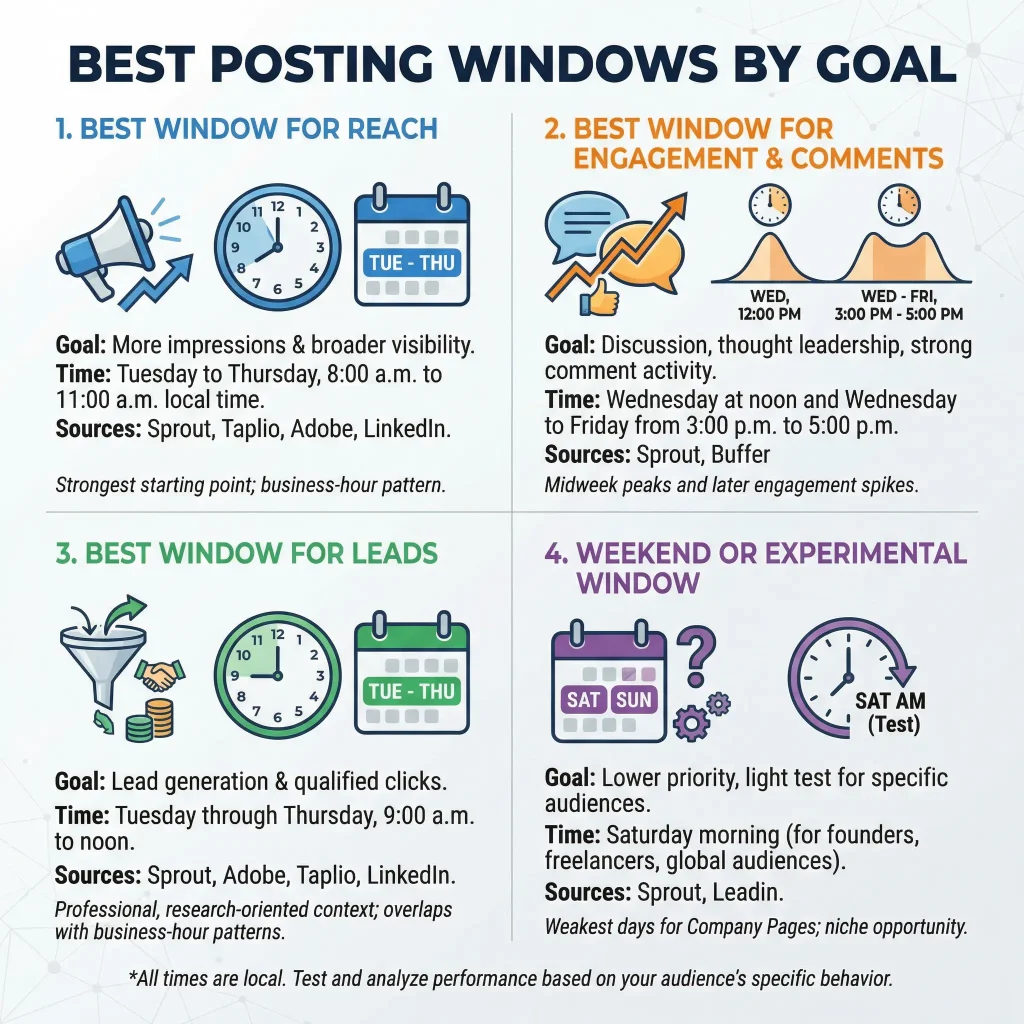
1. Best window for reach
If you want more impressions and broader initial visibility, the strongest starting point—cited by Sprout, Taplio, Adobe, and LinkedIn—is Tuesday to Thursday, 8:00 a.m. to 11:00 a.m. local time. Sprout identifies a business-hour pattern midweek; Taplio recommends 8:00 a.m. for maximum reach; Adobe’s window is 9:00 a.m. to noon; and LinkedIn highlights weekday work breaks as a smart starting point.
2. Best window for engagement and comments
If your goal is discussion, thought leadership, or strong comment activity, test Wednesday at noon and Wednesday to Friday from 3:00 p.m. to 5:00 p.m. Sprout sees midweek engagement peaks at noon, while Buffer’s latest research highlights later engagement spikes on Wednesday at 4:00 p.m. and Friday at 3:00–4:00 p.m.
3. Best window for leads
There is less direct public data on the optimal time for organic posting for lead generation than for engagement, so this recommendation is based on multiple sources. If your goal is leads, start with Tuesday through Thursday, 9:00 a.m. to noon. That window overlaps with the strongest business-hour patterns from Sprout, Adobe, Taplio, and LinkedIn’s own point that the platform works well because people arrive in a professional, research-oriented context. Helpful, insight-driven posts are more likely to attract qualified clicks during those hours.
4. Weekend or experimental window
For most brands, weekends are still a lower priority. Sprout marks Saturday and Sunday as the weakest days for Company Pages. Still, if you sell to founders, freelancers, or global audiences, a light test on Saturday morning can be worthwhile. That nuance appears in both Sprout and Leadin.
Best Days and Times to Test First
Here is a simple order of priority:
- Tuesday: best first test day for reach; start with 8:00–11:00 a.m.
- Wednesday: strongest all-around test day; try 8:00 a.m., noon, and 4:00 p.m., depending on whether you want reach or engagement.
- Thursday: strong for business audiences; test 8:00 a.m., noon, and a secondary 5:00 p.m. slot.
- Friday: useful for leads and wrap-up content; test 7:00–11:00 a.m. first, then 3:00–4:00 p.m. for engagement-heavy posts.
- Monday: usually weaker, but late morning can still work for planning or insight posts.
- Weekend: only test if your audience is known to be active on that platform.
Benefits of Posting at Better Times
Better timing will not save weak content, but it increases the chances that good content gets seen early. For lead teams, this can mean more qualified clicks, profile visits, and stronger thought-leadership exposure. LinkedIn’s resources also highlight that organic content builds buyer relationships and warms audiences before paid campaigns.
Risks or Limitations
The main risk is treating any benchmark like a law. These studies are not measuring the exact same thing. Buffer measures engagement from posts sent through Buffer; Sprout analyzes engagement across many social profiles and records times globally as local-hour equivalents; Adobe mixes survey behavior with search trends; and Taplio refreshes a smaller but very current pool of scheduled posts. That is why you should trust the pattern, but still test the exact window yourself.
Company Pages and personal profiles may behave differently. Sprout’s article focuses on Company Pages. Buffer says its advice applies to both brand and personal profiles. If you use founder-led marketing, late afternoon may work better than it does for Company Pages. This conclusion comes from how datasets are described.
Best Practices
- Post in your audience’s local time. Buffer and Sprout both say their recommendations are meant to be read as local-hour guidance rather than converted to a single master time zone.
- Reply fast. LinkedIn recommends responding to engagement as close to real time as possible.
- Publish useful content, not sales copy. LinkedIn says content with clear, actionable steps and less overt promotion performs best, and it has increased emphasis on knowledge-based content.
- Use analytics, not guesswork. LinkedIn and Sprout both recommend reviewing analytics to find what resonates, even if native analytics do not always show exact active hours.
- Support lead campaigns with organic content. LinkedIn’s Page guide recommends warming up audiences with complementary organic posts before paid campaigns.
Step-by-Step Guide
The best way to find the right posting time on LinkedIn is to test a small set of time slots, measure performance against goals, and refine your schedule using real audience data. For most B2B teams, the To find the best time to post on LinkedIn, try a few different time slots, track how your posts perform, and adjust your schedule based on what your audience responds to. For most B2B teams, good times to start are Tuesday mornings, Wednesday around noon, and late Wednesday or Friday afternoons.
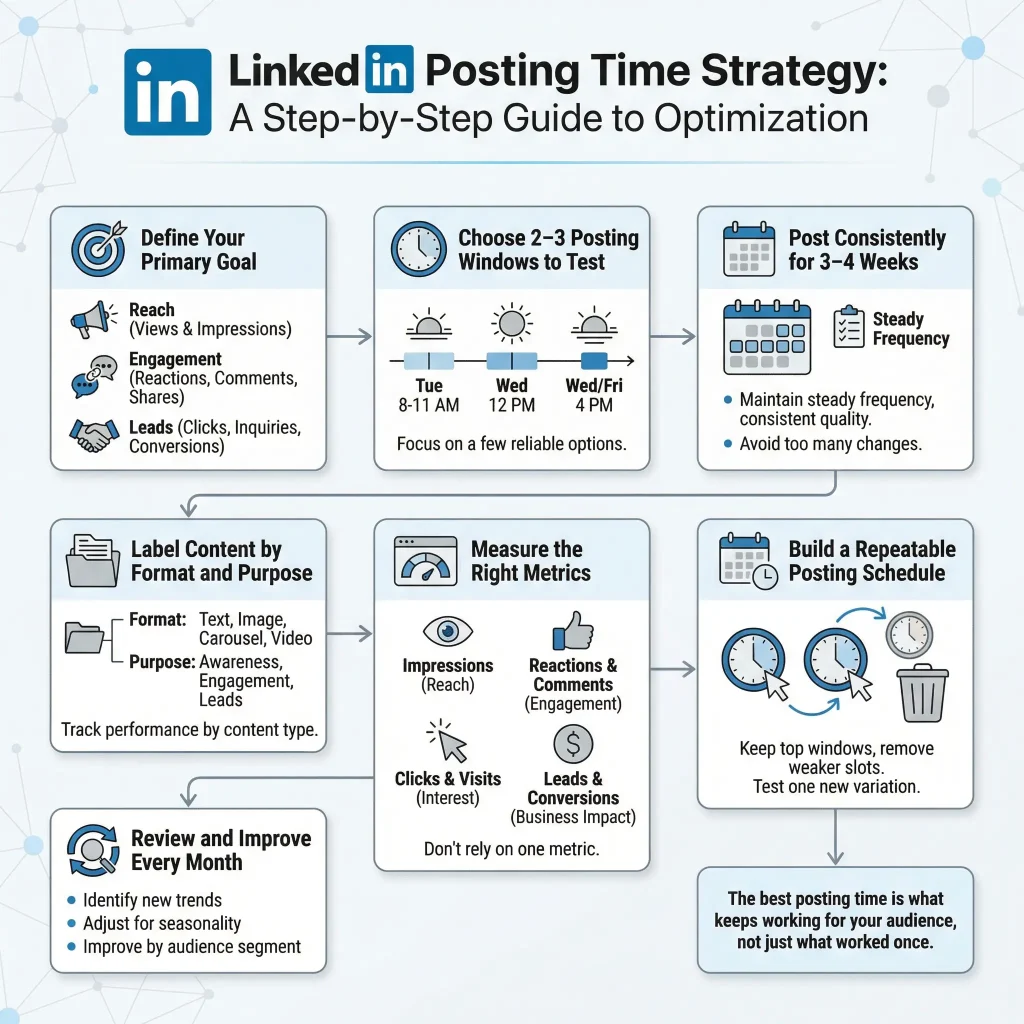
Step 1: Define Your Primary Goal
First, decide what you want your LinkedIn posts to accomplish. This is important because the best time to get more views may not be the best time to get leads.
Your main goal may be:
- Reach for more impressions and visibility.
- Engagement for reactions, comments, and shares
- Leads for clicks, inquiries, or conversions
When you know your main goal, it is much easier to see if your posting time is working.
Step 2: Choose 2–3 Posting Windows to Test
Rather than testing lots of time slots at once, start with just a few reliable options. This keeps things simple and makes it easier to compare your results.
A practical starting setup includes:
- Tuesday, 8:00 a.m. to 11:00 a.m.
- Wednesday, around 12:00 p.m.
- Wednesday or Friday, around 4:00 p.m.
These time slots let you see how your audience behaves in the morning, midday, and late afternoon.
Step 3: Post Consistently for 3–4 Weeks
After you pick your test times, stick with them for at least three to four weeks. Testing for a shorter period usually does not provide enough data to spot real patterns.
During this period, try to:
- maintain a steady posting frequency
- keep content quality consistent
- avoid changing too many variables at the same time
This approach helps you find out if your posting time is really making a difference.
Step 4: Label Content by Format and Purpose
To gain better insights, keep track of the content you post and what you want each post to achieve.
For example, you can label posts by:
- format, such as text, image, carousel, video, or link post
- purpose, such as awareness, engagement, or lead generation
- audience type, such as prospects, clients, or industry peers
This makes it easier to notice which types of posts work best. If you want a simpler way to manage those labels across campaigns and platforms, use a content calendar for brands and agencies.
Step 5: Measure the Right Metrics
Don’t judge your posting times by just one metric. A time that gets lots of views might not get many clicks or leads.
Review performance based on your goal:
- Impressions for reach
- Reactions and comments for engagement
- Clicks and profile visits for interest
- Leads or conversions for business impact
Tracking the right numbers helps you see what is really working.
Step 6: Build a Repeatable Posting Schedule
After a few weeks of testing, pick the two best time slots for each post type or goal. Use these as your regular posting times.
At this stage, you can:
- keep the top-performing windows
- remove weaker time slots
- test one new variation at a time
- refine by audience location or campaign type
This way, you can move from general advice to a LinkedIn strategy that fits your own results.
Step 7: Review and Improve Every Month
Your audience behavior may change over time, especially as your campaigns, industry trends, and content mix evolve. That is why your schedule should be reviewed regularly.
A monthly review helps you:
- identify new timing trends
- adjust around seasonal campaigns
- improve performance by audience segment
- Make sure your posting schedule matches your lead goals.
The best time to post is the one that keeps working for your audience, not just what worked once.
Practical Tips or Real Examples
B2B SaaS company page: Start with Tuesday and Thursday at 9:00–11:00 a.m. for case studies, product education, and webinar promotion. If the page gets more comments than clicks, add a Wednesday 4:00 p.m. thought-leadership post and compare downstream demo requests.
Founder-led consulting profile: Test both morning and late afternoon. Personal-brand content often benefits from stronger conversation signals, so Wednesday 4:00 p.m. and Friday 3:00–4:00 p.m. are worth testing alongside Tuesday morning.
Recruiting or employer-brand page: Prioritize Tuesday through Thursday mornings, and publish content that helps professionals learn, grow, or visualize themselves at the company. That aligns with LinkedIn’s own guidance on professional growth and value-driven posting themes.
Conclusion
The best time to post on LinkedIn isn’t a single magic hour. For most brands, the best starting point is Tuesday through Thursday, 8:00 a.m. to noon local time, especially if the goal is reach or lead generation. Then add a second test window on Wednesday or Friday in the late afternoon if you want more comment-driven engagement. The real advantage comes from combining smart timing with useful content, real-time replies, and consistent testing. That is how reach turns into trust, and trust turns into leads.
FAQs About the Best Time to Post on LinkedIn
What is the best time to post on LinkedIn overall?
The best starting window is usually Tuesday through Thursday during business hours, especially morning to midday. For many B2B brands, this is the safest range to test first.
What are the best days to post on LinkedIn?
The best days to post on LinkedIn are usually Tuesday, Wednesday, and Thursday. Midweek tends to bring stronger visibility and engagement than weekends.
Is it better to post on LinkedIn in the morning or the afternoon?
Morning is usually the safest time to reach. However, late afternoon can also work well for engagement-focused or thought-leadership posts.
Should I post in my time zone or my audience’s time zone?
You should post in your audience’s primary time zone. That gives your content a better chance of being seen when your ideal readers are active.
Is posting on LinkedIn during the weekend worth it?
In most cases, weekends are less effective than weekdays. Still, niche audiences such as founders, freelancers, or global professionals may justify limited weekend testing.
How often should I post on LinkedIn?
A practical starting point is 2 to 5 posts per week. That is frequent enough to stay visible without lowering quality.
Do personal profiles get better reach than LinkedIn company pages?
In many cases, personal profiles get stronger organic reach than company pages. Company pages still matter, but profile-led content often drives more conversation.
How long should I test a LinkedIn posting schedule?
Test a posting schedule for 3 to 4 weeks before making major changes. That usually gives you enough data to compare timing and content performance.
Does content type affect the best time to post on LinkedIn?
Yes, content type can affect performance. A thought-leadership post may perform differently from a link post, carousel, or hiring update.
Does posting time matter more than content quality?
No. Timing helps more people see your post, but strong content is still the main driver of reach, engagement, and leads.

